← All articles
Society
Elections in Saxony-Anhalt: AfD wins without absolute majority, Siegmund extends hand under conditions
The provisional results of 6 September 2026 confirm a historic victory for the AfD in Saxony-Anhalt with 43.8% of the vote and 39 seats out of 83, without reaching the absolute majority of 42. Ulrich Siegmund, lead candidate, called on forces ready for a “political turning point” to cooperate, while ruling out a minority government and threatening new elections, which broadly corresponds to the live headlines from Le Monde and the analyses from franceinfo or Courrier international.
By Georges Darmond, published on 07.09.2026
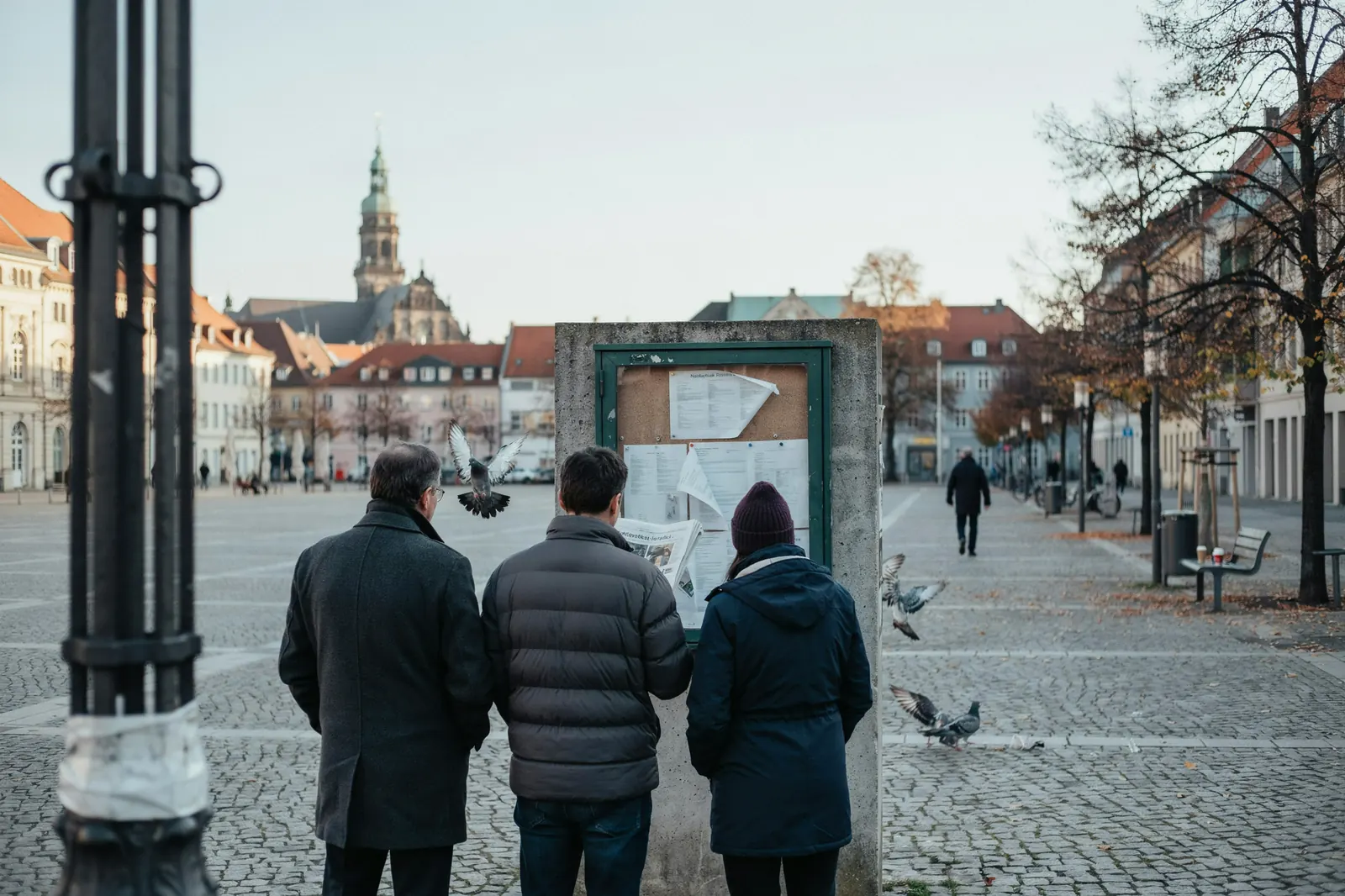
Generated illustration Illustration générée — ne constitue pas une photographie réelle.
The regional elections of 6 September 2026 in Saxony-Anhalt (Sachsen-Anhalt), an eastern German state of about 2 million inhabitants, placed the Alternative für Deutschland (AfD) overwhelmingly in the lead. According to the official provisional result from the state electoral authority, published on the night of 6 to 7 September, the party obtained 43.8% of the vote (compared with 20.8% in 2021), or 39 seats out of 83 in the Magdeburg Landtag. It is three short of an absolute majority (42 seats). The CDU of outgoing Minister-President Sven Schulze collapsed to 17.2% (15 seats, compared with 37.1% and 40 seats in 2021). Next came the SPD (9.3%, 8 seats), the Greens (8.9%, 8), Die Linke (8.6%, 8) and the Bündnis Sahra Wagenknecht (BSW, 5.3%, 5 seats). The FDP was eliminated with 2.6%. Turnout reached a record 77.8%. These figures are confirmed by Die Zeit, Reuters, MDR, tagesschau, Wikipedia (sources: state statistics) and multiple German and international media.
Ulrich Siegmund, 35, AfD lead candidate and candidate for Minister-President, hailed a “historic result” and a “mandate to govern.” Before the vote, he had repeatedly said he wanted to govern only with a stable absolute majority, refusing coalitions and a minority government so as not to dilute his programme (strict migration control, “remigration,” ending certain inclusion or diversity programmes, revision of public broadcasting contracts, etc.). On election night and the following day, faced with the absence of a majority, he nuanced his position: the hand is extended to the “forces” ready for a “fundamental political change” and sharing the AfD’s priorities, without “betraying themselves” or engaging in “political games.” He ruled out an AfD minority government and described certain BSW proposals (notably a non-partisan Minister-President) as “amateurism” or “nonsense.” He raised the possibility that individual MPs from other groups could support an AfD executive, and threatened new elections (“in the worst case”) in which the AfD could reach 50-55%. Federal co-chairs Alice Weidel and Tino Chrupalla went further in claiming the mandate to govern and offering talks to all. These statements are reported by ARD/ZDF, Reuters, Die Zeit, Süddeutsche Zeitung, n-tv and others.
Le Monde’s live headline (“Ulrich Siegmund calls on parties to ally with the AfD in Saxony-Anhalt; the far-right party falls short of an absolute majority”) faithfully reflects this situation: a conditional call for cooperation and the absence of an absolute majority. Franceinfo speaks of a “political earthquake” and a first for the far right since 1945 at state level; Courrier international and Les Echos highlight the “earthquake” for the conservatives of Friedrich Merz. These journalistic formulations are proportionate to the facts, even if the “earthquake” remains an analysis: it is the AfD’s best score in a regional election, a doubling, a snub for the CDU in federal power since 2025, and a major test of the “firewall” (Brandmauer) that all other parties officially maintain against the AfD (classified as “proven right-wing extremist” by the state’s Verfassungsschutz).
Context: the AfD has dominated the east for years on rejection of immigration, the cost of living, a sense of post-reunification decline and criticism of the “established parties.” Siegmund, a former seller of ambient fragrance diffusers, a media and social-media figure, personified a more “accessible” image while defending a radical programme. No coalition had been formed as of 7 September. The CDU refuses any cooperation with the AfD as with Die Linke; the BSW says it is open to discussions but not necessarily to electing Siegmund. An alternative anti-AfD majority (CDU + SPD + Greens + Linke + BSW = 44 seats) is arithmetically possible but politically explosive. Speculation is circulating about possible CDU defectors, without confirmation.
What is established: AfD victory without an absolute majority; Siegmund’s conditional calls for cooperation; mutual displayed refusal of the firewalls. What remains uncertain or ongoing: the exact composition of the future government, the length of any negotiations, the risk of new elections, the impact on the 20 September votes in Berlin and Mecklenburg-Western Pomerania, and federal repercussions for Merz. No evidence of a concrete alliance yet exists. Sensational headlines (“earthquake,” “first since 1945”) correspond to the historical reality of a far-right party at the gates of a regional executive, but the formation of an AfD government is not assured.
Provisional conclusion: the statement under review, drawn from the lives and analyses of Le Monde, franceinfo and others, is broadly accurate on the results and on Siegmund’s call. It correctly describes a major political shift without overestimating (at this stage) effective access to power. What follows will depend on negotiations in the coming days or weeks, under the watchful eye of Berlin and Europe.

Profile
Georges Darmond
Journaliste politique mediasJe m'appelle Georges. Je suis née dans la région parisienne où j'exerce mon métier de journalisme depuis 1 an dans le domaine du de la politique, médias, social. Aujourd'hui, je m'intéresse tout particulièrement à aux promesses non tenues, aux fausses informations, aux affirmations douteuses qui influencent notre quotidien, nos espoirs et notre espérance dans le futur.
LinkedIn ↗