← All articles
Society
Bardella's European tour: controversies over immigration and Ukraine, between facts and media framing
The Monde headline of September 6, 2026 asserts that the RN president's tour of the United Kingdom and Italy turned into a fiasco, undermined by a migration pact with Nigel Farage and statements on aid to Ukraine. The trips, the signing of a memorandum and the political criticism are established; the judgment of "fiasco" falls under journalistic analysis, while the RN's positions on Kyiv remain nuanced and contested both internally and externally.
By Georges Darmond, published on 06.09.2026
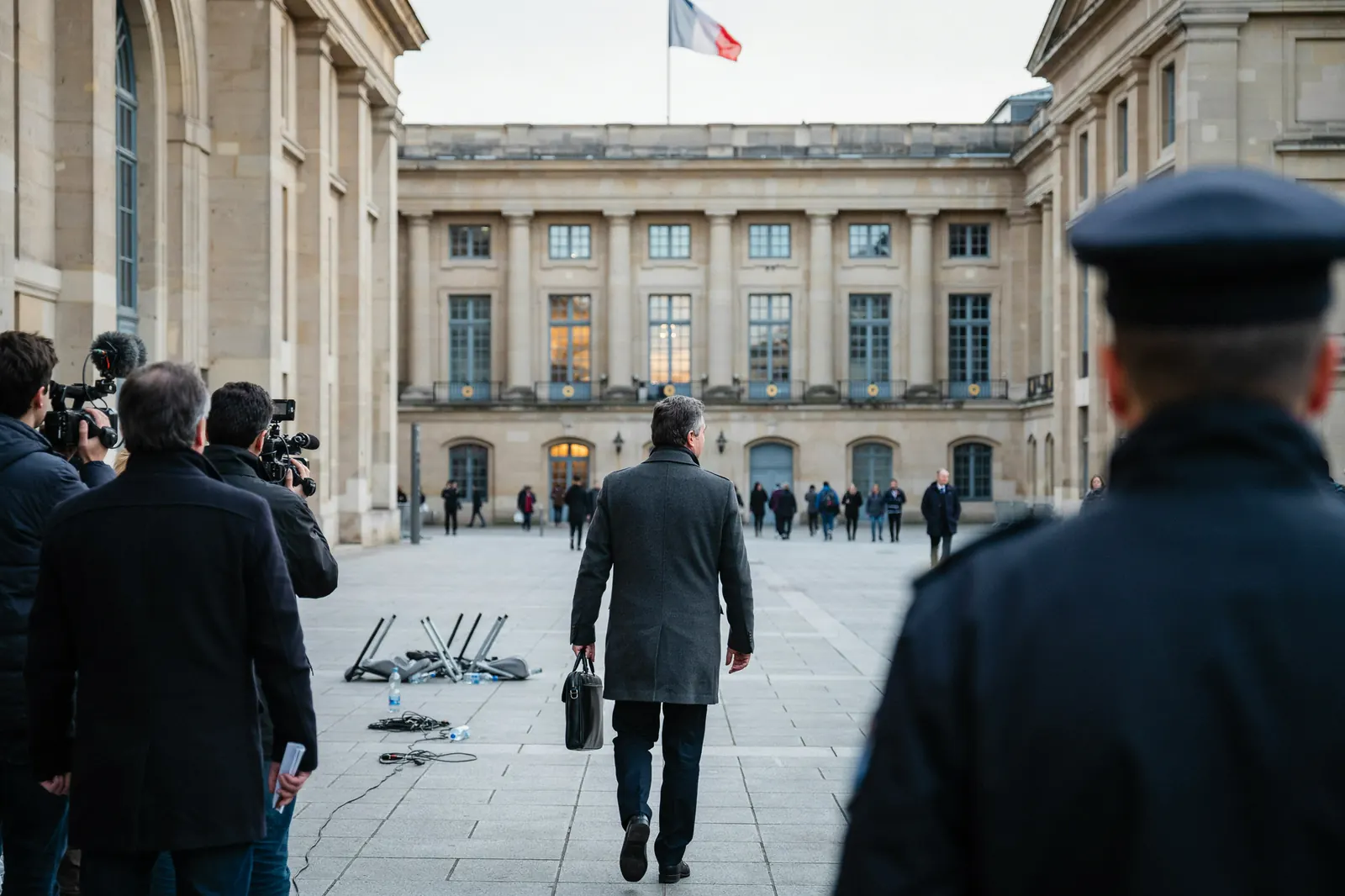
Generated illustration Illustration générée — ne constitue pas une photographie réelle.
On September 6, 2026, Le Monde publishes a dossier titled "Jordan Bardella's European tour undermined by controversies". The article describes the visits by the president of the Rassemblement national (RN) to Birmingham (United Kingdom) on September 4 then to Cernobbio (Italy) on September 5 as a European charm offensive that failed in the face of the immigration and support for Ukraine dossiers. Bardella had to explain himself live on BFMTV from the shores of Lake Como. Here is what can be established, what remains a matter of statement or interpretation, and the blind spots.
Context and origin of the buzz. With the 2027 presidential election approaching, in which Marine Le Pen and Jordan Bardella occupy the RN forefront, the party president multiplies European trips to polish the movement's international image and solidify the Patriots group. On September 4, he is guest of honor at the Reform UK conference in Birmingham. The following day, he speaks at the Ambrosetti economic forum in Cernobbio. These dates coincide with internal RN statements on Ukraine and with the signing of a joint text with Nigel Farage. Press headlines (Le Monde, Les Echos, Mediapart, BFMTV, Reuters, BBC) multiply rapidly, also relayed on X.
Established facts on the British side. On September 4, 2026, Jordan Bardella and Nigel Farage sign in Birmingham a "memorandum of understanding" between the RN and Reform UK. The document, conditioned on both formations coming to power, provides in particular for: a restrictive migration policy on both sides; interception by the United Kingdom of boats that left the French coasts and entered its territorial waters and the return of the people on board to France; "ordinary" acceptance by France of these people, who would then be repatriated to their country of origin under French law; a mechanism for sharing border security costs. Bardella declares in English before activists that if the RN governs, "France will no longer be the gateway for illegal immigration to the United Kingdom". Farage speaks of a "new entente cordiale" and an agreement to "stop the boats forever". Excerpts from the MoU and reports (BBC, Reuters, Telegraph, Politico) confirm these elements. It is a political commitment between parties, not a state treaty.
Established facts on Ukraine. On the evening of September 3, on BFMTV, Louis Aliot, RN mayor of Perpignan and vice-president of the party, takes up the expression "turn off the tap" on aid to Ukraine in the event of a Marine Le Pen victory in 2027. He invokes French public finances "on the bone" (health, education, economy) and the need to "know how to stop a war". These remarks immediately trigger reactions: Édouard Philippe (Horizons) estimates on X that "turning off the tap to Ukraine is serving Russia"; Gabriel Attal and other candidates multiply criticisms accusing the RN of weakness or proximity to Moscow. Marine Le Pen replies by recalling her call for a peace conference, without explicitly disavowing Aliot. On September 5, from Italy, Jordan Bardella clarifies his line: the RN supports Ukraine and will continue to do so, but refuses to finance "ad vitam æternam" a war with money France does not have (a debt of about 3,500 billion euros mentioned) without repayment guarantees. He distinguishes defensive military, humanitarian and training support maintained as long as it is compatible with French rearmament, and opposes deliveries that would endanger national stocks. He had already voted against the European loan of 90 billion euros to Ukraine in the European Parliament. These positions are documented by Le Monde, RTL, franceinfo, Politico and BFMTV.
The Italian sequence and the media clarification. In Cernobbio, Bardella speaks on immigration (described as the greatest European challenge), argues for a referendum in France (abolition of birthright citizenship, border control, processing of asylum in consulates of origin, national priority), salutes the stability brought by Giorgia Meloni and stresses that the "first border" to protect is at Lampedusa via Frontex, rather than between France and Italy. He dines with Matteo Salvini. On the evening of September 5, he explains himself at length on BFMTV: he defends the protocol with Farage as a means of reducing immigration on both sides of the Channel and not as a commitment to massively welcome pushed-back migrants; he denies tensions with Marine Le Pen ("unwavering political affinity"); he nuances Aliot's formula while maintaining budgetary prudence on Ukraine. Excerpts and summaries of the program are available on the BFMTV website.
What is false, exaggerated, incomplete or still uncertain. The Monde title and standfirst present the tour as a "fiasco" that "reduced to nothing" the charm offensive. This is an editorial characterization, not a measurable fact (no immediate impact poll, no event cancellations). The Farage-Bardella protocol is sometimes summarized as a "pact" committing France to become England's "doorman"; the text says "ordinarily accept", leaving room for maneuver, and Bardella insists on first stopping departures from France. Accusations of "submission to Russia" or of the RN's "true pro-Putin face" rest on the party's history (past Russian loan, earlier positions) and on the vote against certain funding, but Bardella and Le Pen publicly affirm support for Ukraine while refusing escalation and prioritizing French finances. No public evidence at this stage establishes an effective Bardella-Le Pen rupture; both officials deny it. On X, reactions oscillate between mockery (Bardella "trapped" by Farage) and defense of the sovereignist line, without major new factual contribution.
Contradictions and blind spots. Inside the RN, Aliot (close to Le Pen) uses a blunt formula while Bardella (more "European" in discourse) nuances with conditions. Observers (Politico) have long noted possible divergences on Russia, NATO and Ukraine between the two leaders. The MoU does not settle the operational detail (who pays what, what exact legal status of returned persons, compatibility with international and European law). The tour aims at image, but runs up against the French political calendar in which Ukraine and immigration are polarizing themes. Primary sources (MoU text available via Reform UK, filmed statements, EP votes) exist; divergent interpretations do too. The RN's right of reply consists in stressing the continuity of its discourse on migration control and budgetary responsibility.
Provisional conclusion. The facts of the tour (Birmingham + Cernobbio), of the signing of the memorandum with Farage and of Aliot's statements then Bardella's clarifications are solidly established by credible and cross-checked press sources (Le Monde, BBC, Reuters, BFMTV, Politico). The controversies are real and forced a media clarification. By contrast, qualifying the whole as a "fiasco" or total failure of the image operation falls under analysis and framing, not an indisputable evidence. The RN's positions on Ukraine remain ambiguous in the eyes of its opponents and partly divergent internally; they amount neither to unconditional support for Kyiv nor to an open alignment with Moscow according to recent public statements. The dossier merits follow-up on any concrete translation of the protocol and on the evolution of RN discourse as 2027 approaches. At this stage, Le Monde's assertion correctly describes a difficult sequence for Bardella, while amplifying the judgment of rout.
Profile
Georges Darmond
Journaliste politique mediasJe m'appelle Georges. Je suis née dans la région parisienne où j'exerce mon métier de journalisme depuis 1 an dans le domaine du de la politique, médias, social. Aujourd'hui, je m'intéresse tout particulièrement à aux promesses non tenues, aux fausses informations, aux affirmations douteuses qui influencent notre quotidien, nos espoirs et notre espérance dans le futur.
LinkedIn ↗