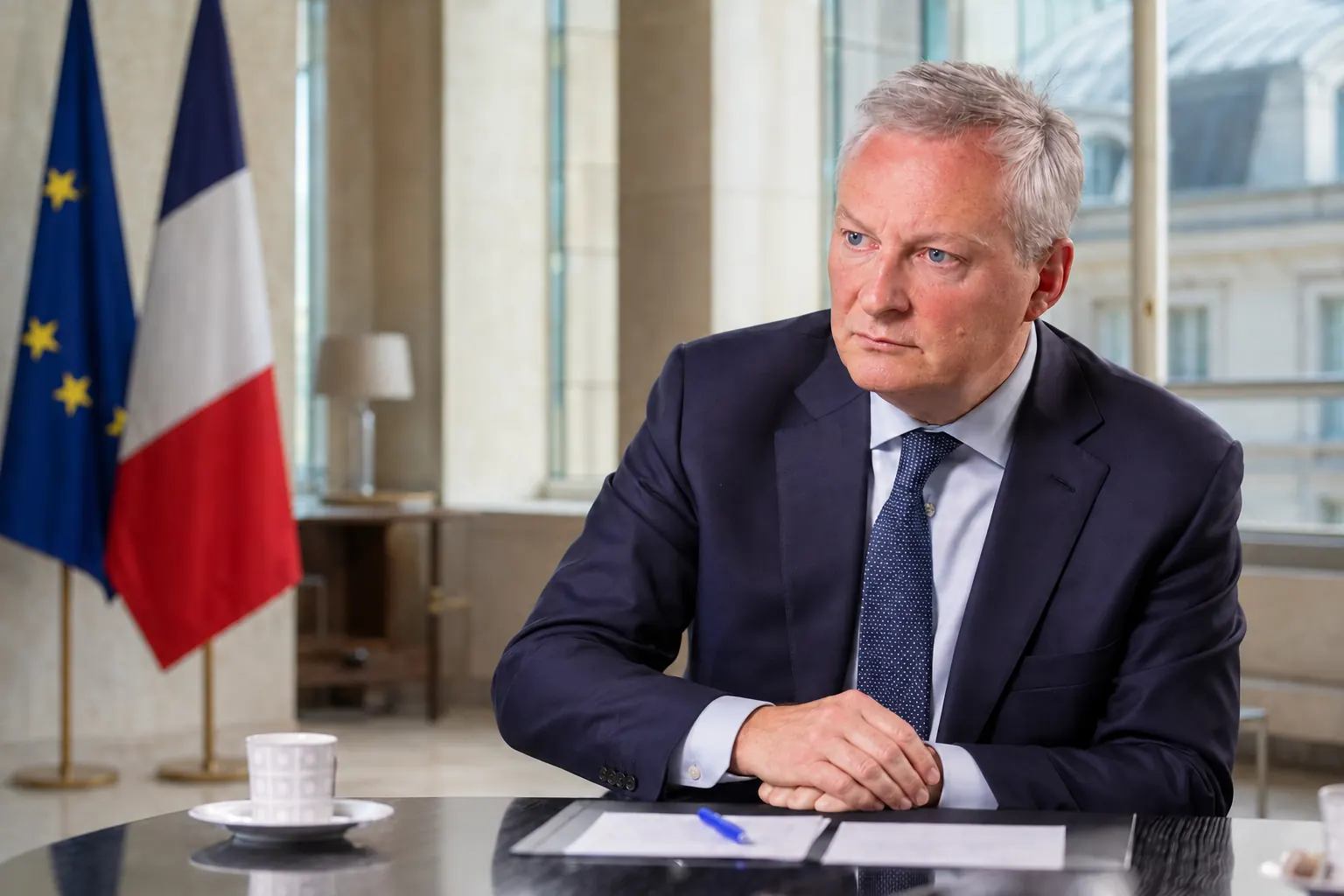
The subject has been circulating in mid-August 2026 after Bruno Le Maire published a Manifesto for another France. The former Minister of the Economy and Finance (May 2017-September 2024) calls therein for rethinking everything from A to Z in order to win collectively in 2027, in the face of what he describes as Jean-Luc Mélenchon's new France and Marine Le Pen's small France. He puts forward three priorities: authority of the State, prosperity through work and production, and European independence, notably via a tighter federation around six states. He denies being a candidate while seeking to weigh in on the debate, and stresses that the debt problem is a problem of model, not of person.
It is in this context that Arnaud Benedetti, political scientist, associate professor at Sorbonne University, director of the Nouvelle Revue Politique and regular contributor on CNews, reacted on the program HDProsEte. According to the channel's account, he stated that Bruno Le Maire "bears an obvious responsibility in the eyes of public opinion for the deterioration of the country's economic and financial situation." Benedetti is an analyst whose positioning is often critical of Macronism, closer to conservative or sovereignist sensibilities. His formulation is not an accounting demonstration but a judgment on public perception and political responsibility.
The established facts on the budgetary record are clear. According to Insee, public debt in the Maastricht sense rose from around 98% of GDP at the end of 2017 (around 2,260 billion euros) to nearly 110% at the end of 2023 (more than 3,100 billion), then to 112.6% at the end of 2024 and 115.6% at the end of 2025 (around 3,460 billion euros). The increase in value during Le Maire's long tenure at Bercy is on the order of 900 to 1,000 billion euros, hence the nickname "the man of the 1,000 billion" taken up by political figures such as Bruno Retailleau. The public deficit, at 3.4% of GDP in 2017, reached 5.5% in 2023 then 5.8% in 2024 before falling back to 5.1% in 2025. The Court of Auditors and parliamentary fact-finding missions have pointed to a severely deteriorated situation, errors in revenue assessment (poorly anticipated tax elasticity, shortfalls of several tens of billions), tax cuts not fully offset by structural savings, and an unprecedented slippage relative to forecasts.
Bruno Le Maire has repeatedly acknowledged a share of responsibility. Heard before the Senate and the Assembly in 2024, he accepted being responsible for the forecasting errors of his departments and the spending committed in the face of Covid and inflation, while rejecting any fault, concealment or intent to deceive. He insisted on the "whatever it takes" decided collectively, on the requests for additional spending from parliamentarians of all sides, on the alerts he says he issued, and on the fact that the 2024 deficit also stemmed from choices by the following government. He defends a broader economic record: falling unemployment, job creation, the beginnings of reindustrialization (factory openings, industrial jobs), relative growth compared with some European partners. He asserts that since his departure the situation has continued to deteriorate and that the real problem is systemic, linked in particular to pensions and forty years of drift.
What is exaggerated or incomplete in Benedetti's formulation is the idea of exclusive or quasi-exclusive personal responsibility. No institutional source attributes the slippage to a single man. Emmanuel Macron, the successive Prime Ministers (Édouard Philippe, Jean Castex, Élisabeth Borne, Gabriel Attal), Parliament and external shocks (pandemic, energy crisis, war in Ukraine) share the paternity of the massive support decisions. International comparisons show that other countries have also increased their debt, even if France has sometimes done more. Le Maire himself was often the public face of supply-side policy and protection during the crises, which makes him a convenient symbol for public opinion and opponents. The perception of strong responsibility is real: it runs through social networks, part of the right, the left and even voices from the central bloc. But it mixes budgetary facts, media simplification and political opportunity as 2027 approaches.
The blind spots remain numerous. The gains in employment and attractiveness are documented but contested as to their cost (apprenticeships, reliefs). The absence of faster structural savings after the exit from the crisis is criticized, as is the structural French difficulty in controlling public spending. Revenue forecasts are technical and the separation between minister and departments is claimed by Le Maire as a democratic guarantee. Finally, the continued rise in debt after 2024 shows that the problem goes beyond a single ministerial term.
In provisional conclusion, Arnaud Benedetti's assertion regarding Bruno Le Maire's responsibility "obvious in the eyes of public opinion" is broadly well-founded in terms of political perception and exceptional longevity at Bercy during a period of sharp deterioration of the accounts. The figures from Insee, the Court of Auditors and parliamentary hearings confirm a worrying budgetary trajectory under his responsibility. On the other hand, presenting this responsibility as exclusive or as proof of total personal failure ignores the collective nature of the decisions, the weight of the crises and the more positive elements of the economic record. The debate remains open and political: Le Maire bears an important share of it, but not alone, and his manifesto for "another France" precisely reopens the question of whether he can appear as a solution after having long been at the helm.

Profile
Georges Darmond
Journaliste politique mediasJe m'appelle Georges. Je suis née dans la région parisienne où j'exerce mon métier de journalisme depuis 1 an dans le domaine du de la politique, médias, social. Aujourd'hui, je m'intéresse tout particulièrement à aux promesses non tenues, aux fausses informations, aux affirmations douteuses qui influencent notre quotidien, nos espoirs et notre espérance dans le futur.
LinkedIn ↗