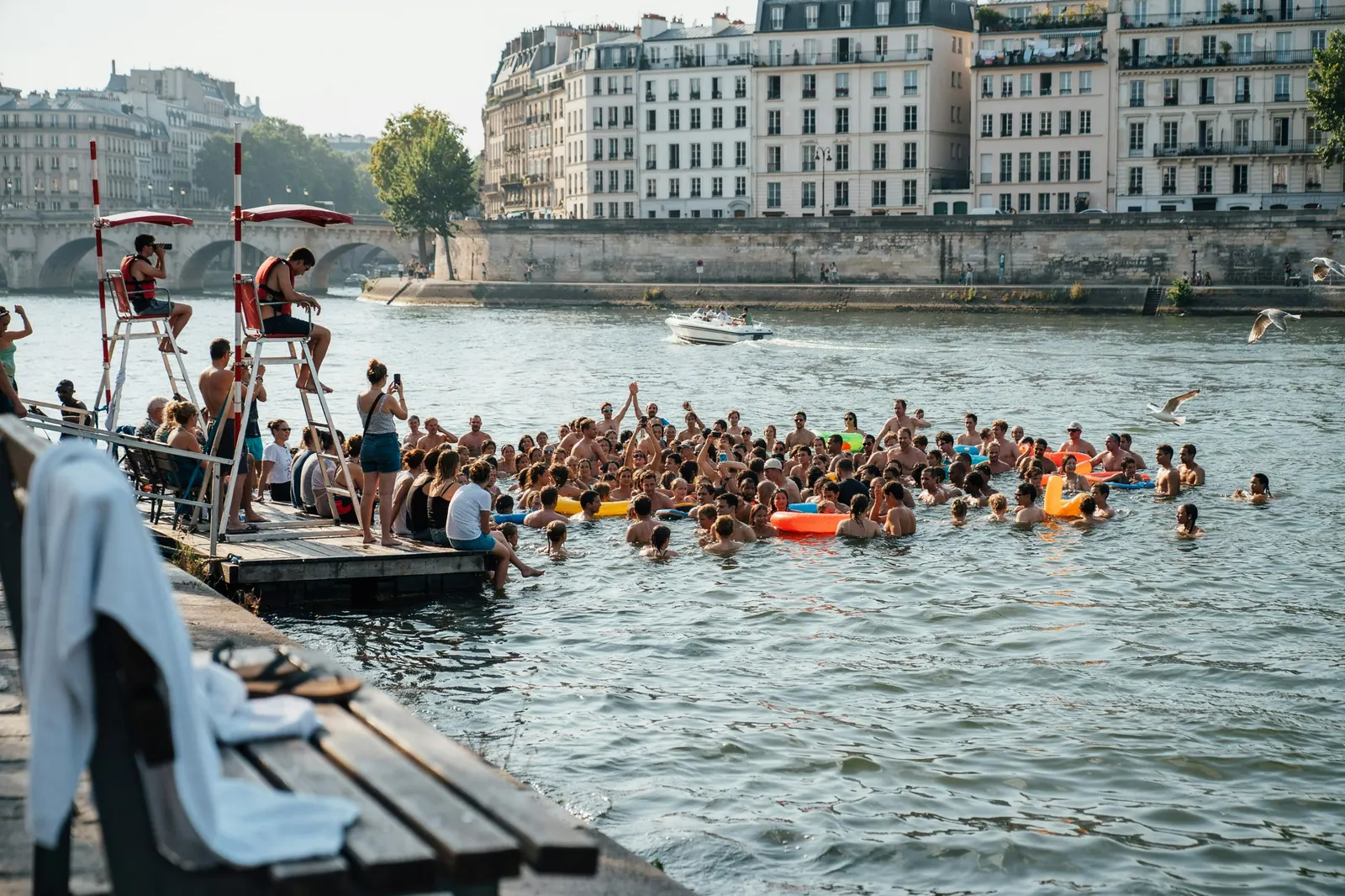
More than 180,000 visitors. 120,000 in the Seine alone. Twenty percent better than in 2025. City Hall released its counters on August 29, 2026, just as the season was taking its bow under the storms. It looks like a weather bulletin that thinks it's a victory communiqué. And for good reason: the Olympic legacy has once again dipped its feet in the water. The facts first, the ones that hold up. According to the report communicated by the City of Paris and picked up without flinching by AFP, Le Figaro, Ouest-France, franceinfo or Le Parisien, the three free sites in the Seine — Bras Marie, Bercy and Grenelle — welcomed 120,000 swimmers over eight weeks. That is twenty percent more than the roughly 100,000 of summer 2025, the first post-century-long ban season. Add the Bassin de la Villette (51,000) and the Canal Saint-Martin (12,000, including 9,000 from mid-June in early opening under heatwave), and one easily exceeds 180,000. The four outdoor summer pools in sports centers push the total to 216,000. City Hall itself writes on paris.fr: "After eight weeks and 216,000 swimmers, this second season confirms a success that shows no sign of abating." One third of the opening days coincided with a heatwave episode. We're not going to complain that the heat acted as a salesperson. Where does the buzz come from? From the obvious. After the 2024 Olympics that forced the cleaning of the river, swimming has become the ultimate urban gadget: free, photogenic, a middle finger to the skeptics who predicted an empty harbor. Emmanuel Grégoire, PS mayor, congratulates himself on it: these sites allowed people to cool off "during a particularly grueling summer." He promises to go further in 2027, with perhaps a Bastille Beach in the Bassin de l'Arsenal. The discourse is well-oiled. So is the figure. But the thermometer has its limits. At the end of July, Bras Marie and Bercy closed intermittently due to fuel oil pollution. And on August 29, the day of the report, the Seine sites lowered the curtain one day early because of storms that degrade the bacteriological quality. La Villette and the Saint-Martin extended a bit. The weather boosted attendance as much as it hindered it. In 2025 already, the July rains had spoiled the party before a catch-up in August. We count the entries, we do not yet publish the detail of open days nor an independent audit of the flows. The figures come from City Hall. They are consistent from one source to another, but remain proprietary data. No one has counted those who dip outside the supervised zones either — and the tragedies, rare, remind that the canal is not a municipal swimming pool. The blind spots? Water quality remains the fragile parent. We open when it's compliant, we close when it's no longer. The public is mostly local, according to 2025 feedback. Tourists are getting into it, but it's not yet Deauville beach. And the "record" is measured against a single reference year. Easy to be a record when starting from zero after a century. Provisional conclusion: the City's statement holds. The 180,000 and the 120,000 with +20% are confirmed by official sources and the credible press of the same day. The heatwave summer did the job. The Olympic legacy project is still floating. Remains to be seen if the success solidifies without the extra heatwaves, and if the water continues to play along. For now, Paris has put the Seine back on the menu. Parisians have put their feet in it. Without swallowing too much water, apparently. And that, for a city that long turned its back on its river, is already not nothing. We smile, we take note, we wait for 2027.