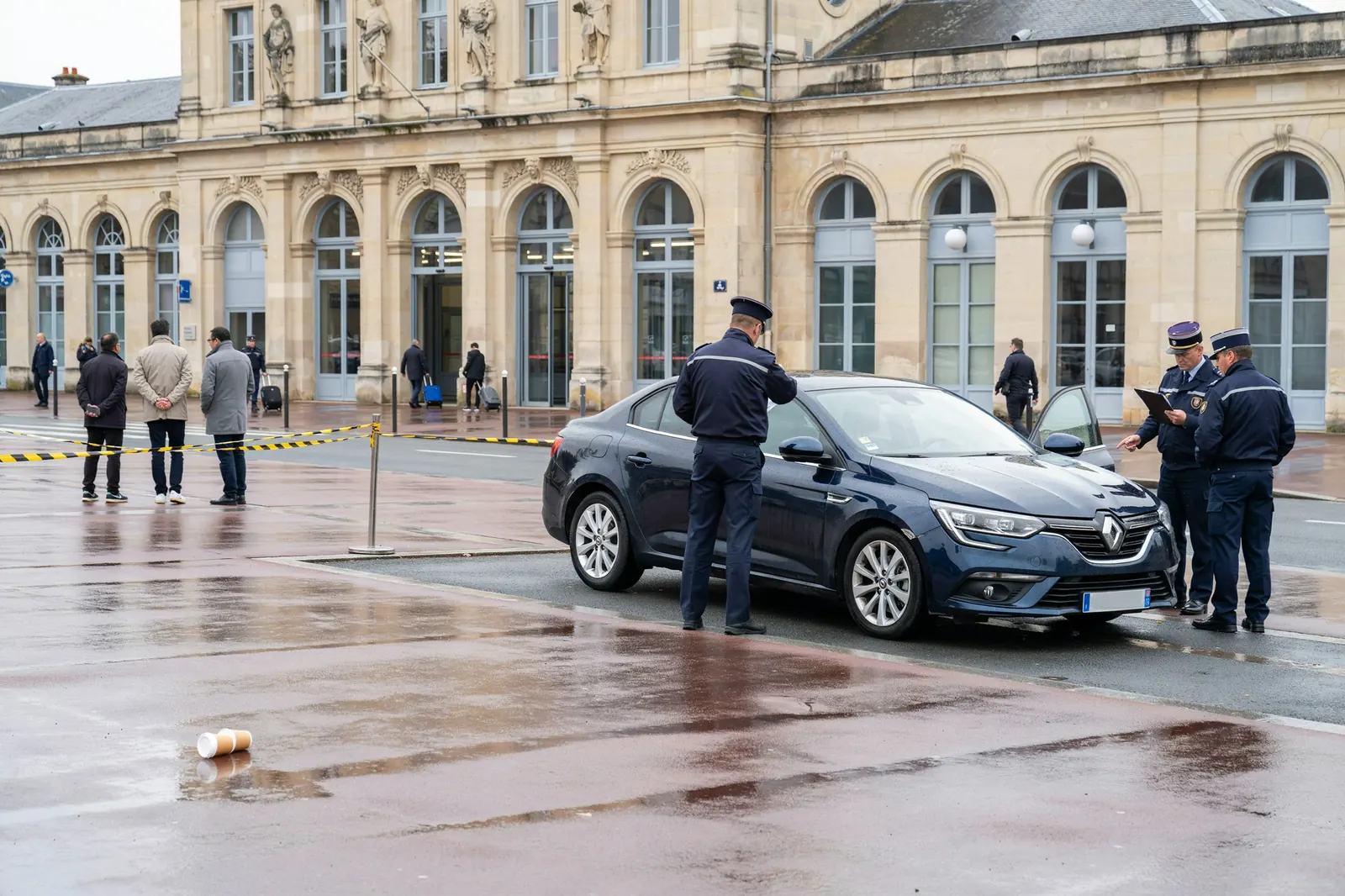
Around 10:15 p.m., opposite Caen train station, a car hits a group of young people sitting or standing near a bus shelter, a tram stop. The prefect of Calvados, David Clavière, on site, sums it up bluntly: “a car deliberately drove into pedestrians who were on the public roadway.” Toll announced during the night: one dead, seven in absolute emergency, three in relative emergency. Eleven victims. Firefighters and police seal off the hotel and fast-food district. Forensics teams collect traces on the roadway. That is the bare skeleton of the facts, confirmed by AFP, Le Parisien, France 24 and most newsrooms.
The driver flees. He is caught in Ouistreham, about twenty kilometers farther on, thanks to cameras. Aged 26, “born in Russia,” known to police “only for traffic offenses,” not to intelligence services. Some sources, including Le Figaro, give the first name Ibrahim I.; the full identity remains under the seal of the investigation. He is placed in custody. Deputy prosecutor Philippe Leonardo opens an inquiry for murder and voluntary violence with a weapon — the car serving as the weapon, as will be understood. And he adds, cautiously: “For the moment we are not, a priori, in the framework of a terrorist motive, but the investigations are only just beginning.” The sentence deserves to be read twice. It says everything we know and everything we do not yet know.
Where does the buzz come from? From a fight, a brawl, an altercation near a bar in the station district. Recurring version: one of the protagonists went to fetch his vehicle and drove into the group. Mayor Aristide Olivier mentions a fight between two groups. The exact reasons for the dispute? Unknown at this hour. The victims, all men according to the first elements, aged 17 to around forty. Nationalities reported: French, Afghan, Egyptian, Bangladeshi. Witnesses identify the first deceased as a young Afghan of 18 or 19. France 3 Normandie and others later announced a second death, a person seriously injured who did not survive at the CHU. The official toll remains fluid; the headlines, for their part, rush ahead.
What is established is the intent according to the authorities: “deliberately.” What is false or premature is to turn the case into an attack before the cameras, the hearings and the motive have spoken. What is incomplete is the portrait of the suspect and the precise sequence of the brawl. What circulates on X and elsewhere is the usual mix: a first name dropped, a nationality pointed at, rumors of a settling of scores. None of that amounts to proof. Contradictory versions still coexist: one dead or two, black BMW or plain German car, group under the bus shelter or on the sidewalk. The blind spots are as wide as a station square on a summer evening.
One leaves these dramas with the same impression. A bar brawl that degenerates into a ram attack, a young man who thinks he can settle scores with four wheels, bodies on the ground, rescuers running, a prefect counting the emergencies. The impertinence is not to laugh at the dead. It is to recall that the communiqué that wants to be gospel always arrives too fast, and that a prosecutor’s “a priori not terrorist” is worth more than a thousand conspiracy theories. The murder inquiry continues. The cameras keep rolling. The motive, for its part, has not yet delivered its ending. In the meantime, Caen has one death too many — or two — and a simple question: what drives a man to turn a brawl into a carnage? The answer, for now, is still rolling in the fog.

Profile
Georges Darmond
Journaliste politique mediasJe m'appelle Georges. Je suis née dans la région parisienne où j'exerce mon métier de journalisme depuis 1 an dans le domaine du de la politique, médias, social. Aujourd'hui, je m'intéresse tout particulièrement à aux promesses non tenues, aux fausses informations, aux affirmations douteuses qui influencent notre quotidien, nos espoirs et notre espérance dans le futur.
LinkedIn ↗