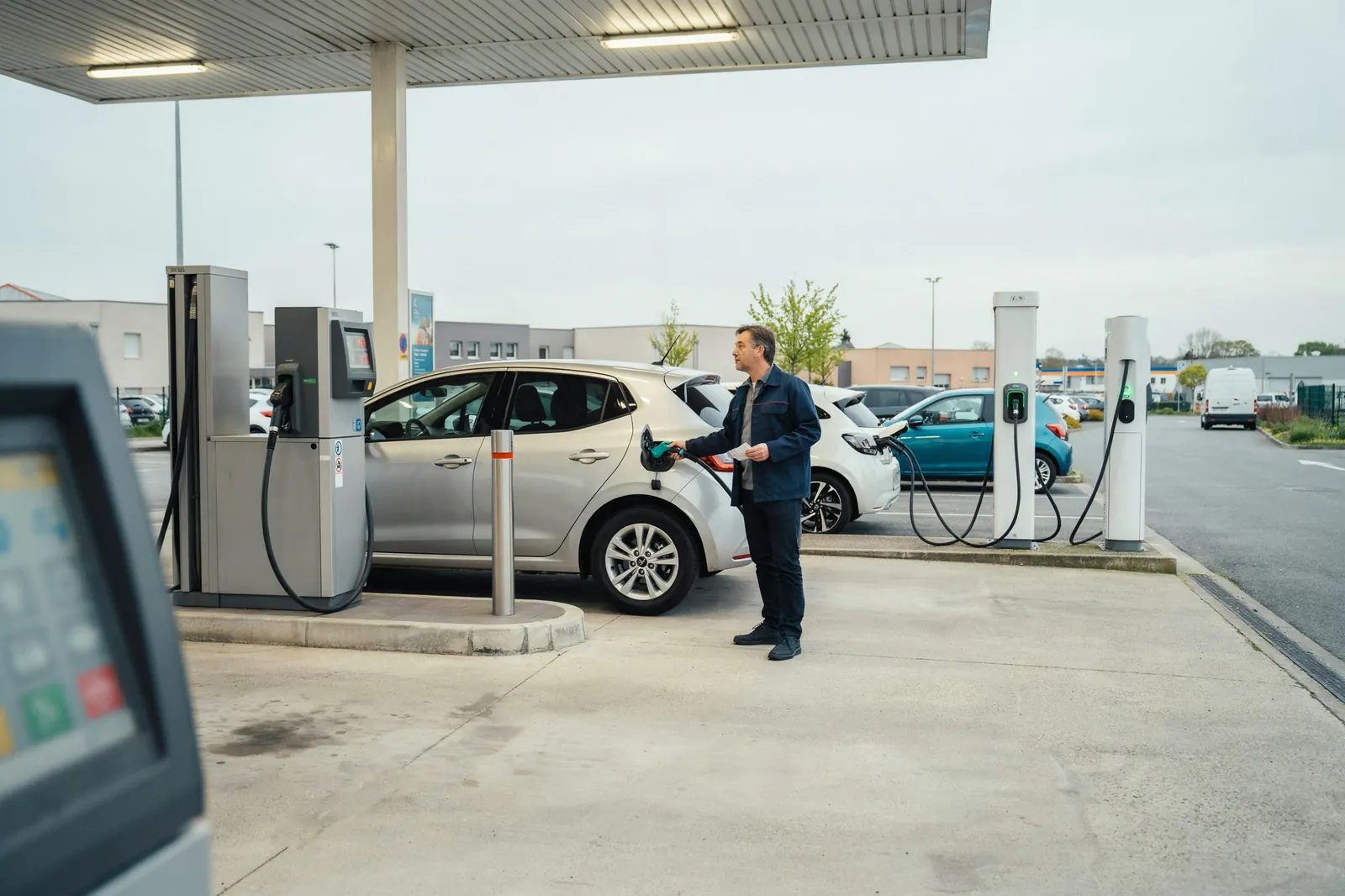
Two euros twenty a liter of diesel. There's the figure that hits harder than a marketing slogan. In April 2026, diesel brushed or exceeded 2.25 euros on the national average, with even higher peaks still. Immediate cause: tensions around the Strait of Hormuz and the conflict involving the United States, Israel and Iran, which drove up the barrel. Franceinfo draws a "tipping point" from this. The French, hand on heart and wallet, are said to have rushed for battery cars. A third of new ones in July. Unthinkable not long ago. Let's see what the counters really say.
The facts first, without frills. According to the Automotive Platform (PFA) and AAA Data, registrations of 100% electric passenger cars reached 44,378 units in July 2026, or 35% market share. Over the first seven months, we're talking nearly 286,000 vehicles, 29% of the total, up about 70% compared with the same period in 2025. The overall new-car market is progressing a little (+9% in July, +2.6% over seven months), but remains far from pre-Covid volumes. Pure combustion engines are collapsing. Hybrids are holding up. The used electric market is also climbing, sometimes by more than 50%. These figures are solid, cross-checked by several industry sources. Not a dealership rumor.
The fuel surge has played a role. From March, order books filled up. A private individual from Rouen recounts in the article that he was spending 100 euros a week on diesel; his Tesla saves him hundreds of euros a month. Transport & Environment calculated in the spring that an electric could save 88 euros monthly at 1,000 km, up to 200 euros for heavy drivers. With gasoline and diesel still durably above two euros at many stations even at the end of August, the "painful fill-up" argument has bite. The experts cited – Bastien Gebel, Bernard Jullien, Marie-Laure Nivot of AAA Data – speak of a real effect and a spread over several months, the time for deliveries. So far, the chronicle holds.
But fuel is not alone at the wheel. Social leasing resumed service on July 16, 2026: 50,000 modest households (reference tax income per share under 16,880 euros) can lease a new electric for less than 200 euros a month, sometimes under 140. Purchase aids between 3,500 and 5,700 euros, or even more for European models. Company fleets pushed to electrify. And catalog prices have fallen: entry-level models like the Renault 5, the Twingo IV or the Citroën ë-C3 around 20,000 euros. A cited study speaks of -4% between 2024 and 2025. When the entry ticket drops and the State digs into its pocket, demand follows. "When the price falls, demand rises," summarizes economist Bernard Jullien. Simple as that. Or like a gas bill.
Is the shift irreversible? The same experts believe so. The machine would be launched. Collective awareness, an offering that is expanding, habits that are changing. Yet blind spots exist. The rolling fleet remains at 3.5% electric at the beginning of 2026. The overall market is still struggling. Highway fast chargers can cost a lot: at more than 0.60 or 0.70 euro per kWh, the gain evaporates for some trips. Chinese brands are climbing (about 8% in July), which delights buyers but agitates European manufacturers. And if the Middle East calms down and the liter drops sustainably below two euros? No one has a crystal ball. A strong correlation is not exclusive causality. Public policies and the drop in prices were already working the ground before the oil shock.
We smile a little. The average Frenchman did not switch out of sudden love for the planet one April morning. He switched because the fill-up made him grimace and the alternative was finally becoming calculable. The impertinence consists in saying it without sugarcoating: ecological virtue often travels in the car of the economy. Franceinfo is right about the acceleration and the figures. It is right to evoke a cocktail – war, aids, prices. It slips a bit quickly into the costume of the definitive "tipping point". For now, it's a fine surge, documented, multi-factorial. Not yet the end of the combustion engine story. Just a chapter where the wallet spoke louder than the speeches. And that, already, is a form of truth that hits hard.

Profile
Georges Darmond
Journaliste politique mediasJe m'appelle Georges. Je suis née dans la région parisienne où j'exerce mon métier de journalisme depuis 1 an dans le domaine du de la politique, médias, social. Aujourd'hui, je m'intéresse tout particulièrement à aux promesses non tenues, aux fausses informations, aux affirmations douteuses qui influencent notre quotidien, nos espoirs et notre espérance dans le futur.
LinkedIn ↗