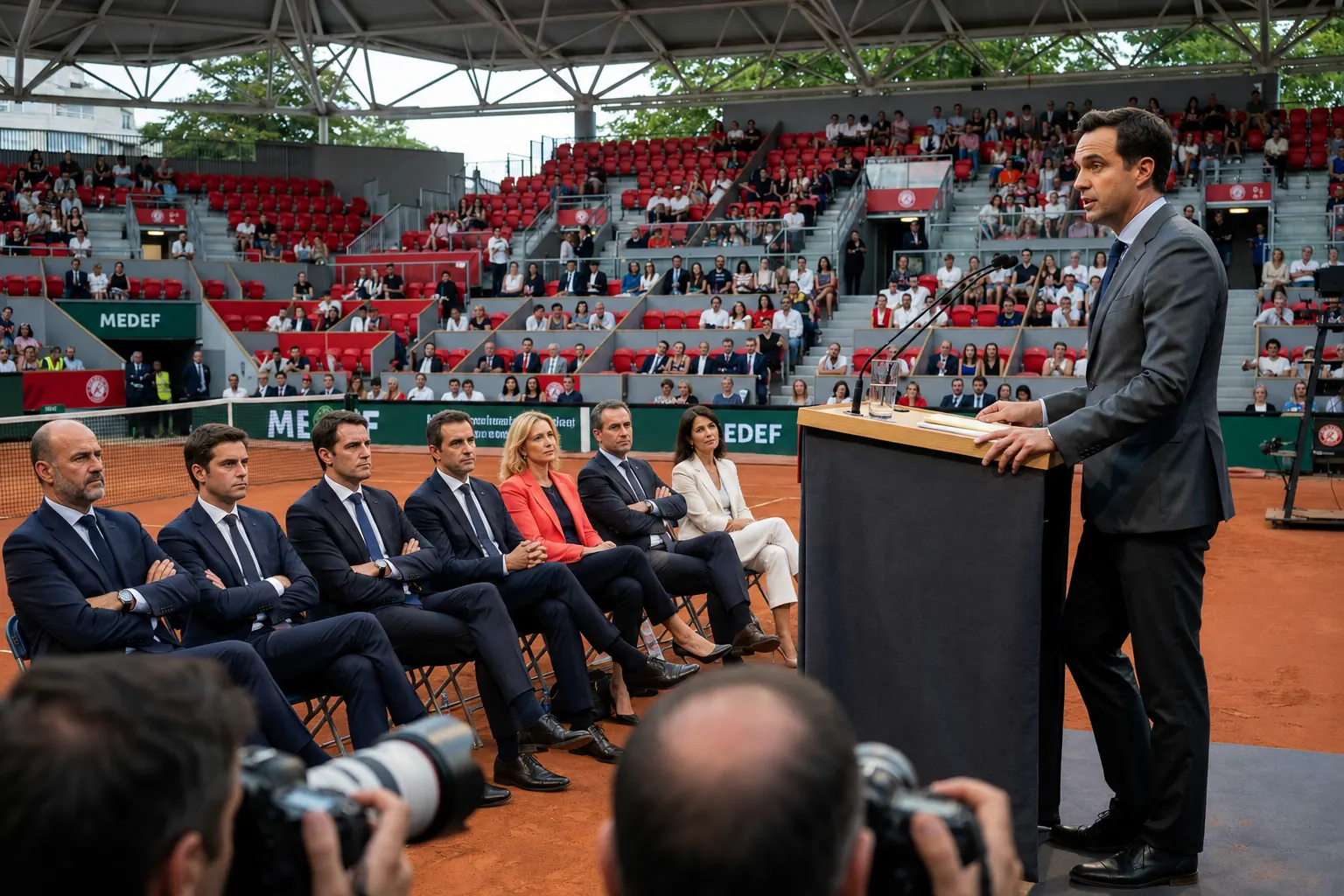
The yellow balls have given way to microphones. This Thursday, August 27, 2026, starting at 4:45 p.m. on Philippe-Chatrier court, the Medef turns its Meeting of France’s Entrepreneurs into the first televised round of the 2027 presidential election. Seven names on the scoreboard: Gabriel Attal, Raphaël Glucksmann, Jean-Luc Mélenchon, Édouard Philippe, Bruno Retailleau, Marine Tondelier and Marine Le Pen. Broadcast live on LCI, the exercise will last about two hours. The candidates react to the results of an OpinionWay consultation conducted among more than 66,000 business leaders. Five SME executives ask the questions. Debt, taxation, reindustrialization, regulations, labor costs. The Medef insists it doesn’t want them to “beat each other up.” You have to be dreaming. Or rather, you think you’re hearing a tournament organizer praying for a match without a red card.
The franceinfo article we’re looking at picks up the phrase: “This is the launch of the campaign.” It comes from Bruno Retailleau’s entourage. Other media, from Le Figaro to TF1 Info by way of HuffPost and RTL, have been singing the same refrain since July. First major early face-off, eight months before the first round scheduled for April 2027. Broad casting, employers’ platform, captive audience of 20,000 announced entrepreneurs. On paper, it hits hard. In the facts, it’s accurate: the event is indeed taking place, the seven have confirmed, the consultation exists, 82% of the bosses surveyed say they are pessimistic about the future president’s economic policy. Stated priorities: lower taxation (83%), reindustrialize (81%), simplify, reduce debt and spending. The Medef wants to impose its themes. Mission partly accomplished even before the first exchange. Patrick Martin, its president, plays the benevolent referee: we’ll work with whoever the French elect, RN or LFI included. Employer pragmatism, 2026 version. We’ve known more passionate declarations of love.
Why strategic for each camp? Here, journalistic analysis reclaims its rights, and the postures too. Marine Le Pen arrives “in a position of strength,” say her people. Polls around 35%, favorite. She must reassure an economic world that sometimes preferred the Bardella version, reputed to be more liberal. Message slipped in: the line is the same, and Jordan will be Prime Minister if needed. Jean-Luc Mélenchon, gaining momentum on the left according to some polls, facing an audience that sees him coming with his taxation of the rich and his ideas on debt. Showdown or facade smile? His camp has barely commented. For Attal and Philippe, internal center duels: differentiate without tearing each other apart too quickly, remind of the “extremes,” promise freedom to businesses. Retailleau seeks to exist in the face of the useful vote. Glucksmann and Tondelier try not to disappear in the Mélenchonist shadow or the ecological divisions. Each comes with their net. Some to score points, others not to lose too many. A close associate of Édouard Philippe sums up the trap: too many challenges and you look like jokers; none and you put the room to sleep. The right tone, that grail of the back-to-school season.
The buzz started early. RTL was announcing it at the end of July. LCI got the exclusive. The number of registrants for the REF has doubled. 650 accredited journalists, unprecedented according to the organization. Mélenchon is said to have said yes first, the others followed. A nice catch for the Medef, which wants to weigh in early and hard. We find the same logic as in 2022 with the grand orals, but in a collective and more spectacular version. Neutral ground? Let’s say chosen ground. The bosses question on their priorities. The candidates know the cameras are rolling and that the clips will go further than the 20,000 seats at Chatrier. An executive invited to ask questions almost confesses: timing too tight for substance, “more of a media exercise.” Thanks for the frankness. It is sometimes lacking in the press releases.
What remains vague or exaggerated? Calling this the “official launch” of the entire campaign amounts to useful emphasis. The campaign has been rumbling for months: summer universities, polls, statements, primaries to come on the left. Not all candidates definitively declared; the 2027 casting will shift. No pure PS representative. And above all, to the right of the right, absentees who weigh: Éric Zemmour and Sarah Knafo will not be on Chatrier. Two figures capable of frankly bothering the present camp — Marine Le Pen as well as Bruno Retailleau — by siphoning off identity talk, by reminding that a seven-person employers’ “grand oral” does not exhaust the spectrum of the right. Their absence suits the scoreboard: less internal competition, more media clarity, an RN and an LR/LR-compatible right that can play without being tugged on their flank. They’re selling a “broad” casting; they’re omitting the troublemakers. Notable absentees, then, and not merely “possible later.” And then, a debate before bosses is not a debate before the French. The themes match entrepreneurial expectations, less necessarily purchasing power as seen from the queue. The extremes come onto ground that is not theirs by nature. Le Pen must deflate the “fantasies.” Mélenchon must decide whether he provokes or plays the statesman score. The center must prove it still has an audible economic compass. Everyone gains a bit of light. The Medef gains a golden platform for its files. TV gains back-to-school audience. The reader, for their part, gains the right to smile: they’re selling us a decisive match when it’s rather a first warm-up round on clay, with serve to the employers’ public.
Slight contradiction in the narrative: franceinfo first lists six names in the body before talking about the seven and expanding on Le Pen. The other sources correct without ambiguity. Nothing serious, just the rush of D-Day. On X, one comes across the usual “why not Asselineau?” and the digs at the ball-boy presidentialism of the employers. Classic background noise. No earth-shattering scoop, no surprise boycott at the time of writing.
Provisional conclusion, stuck to the evidence: yes, the debate takes place this August 27, 2026 at Roland-Garros under the aegis of the Medef with indeed seven major candidates — without Zemmour or Knafo, awkward absentees for the right of the panel. Yes, several camps present it as a launch, and Retailleau’s entourage provided the phrase. Yes, it is strategic to position early on the economy, reassure or provoke, mark the media calendar. No, it is neither the absolute beginning of everything, nor a definitive grand oral that will decide destinies. It is a nice employers’ organization coup, a posture exercise for politicians seeking volume, and a moment when we will see who knows how to talk numbers without losing their electorate. After the noise of the rackets and the press releases, there will remain the clips, the sound bites and, perhaps, a bit of substance. Or not. Promises, as one of the questioning bosses recalled, only bind those who believe in them. In that game, the public is used to being the point editor.

Profile
Georges Darmond
Journaliste politique mediasJe m'appelle Georges. Je suis née dans la région parisienne où j'exerce mon métier de journalisme depuis 1 an dans le domaine du de la politique, médias, social. Aujourd'hui, je m'intéresse tout particulièrement à aux promesses non tenues, aux fausses informations, aux affirmations douteuses qui influencent notre quotidien, nos espoirs et notre espérance dans le futur.
LinkedIn ↗