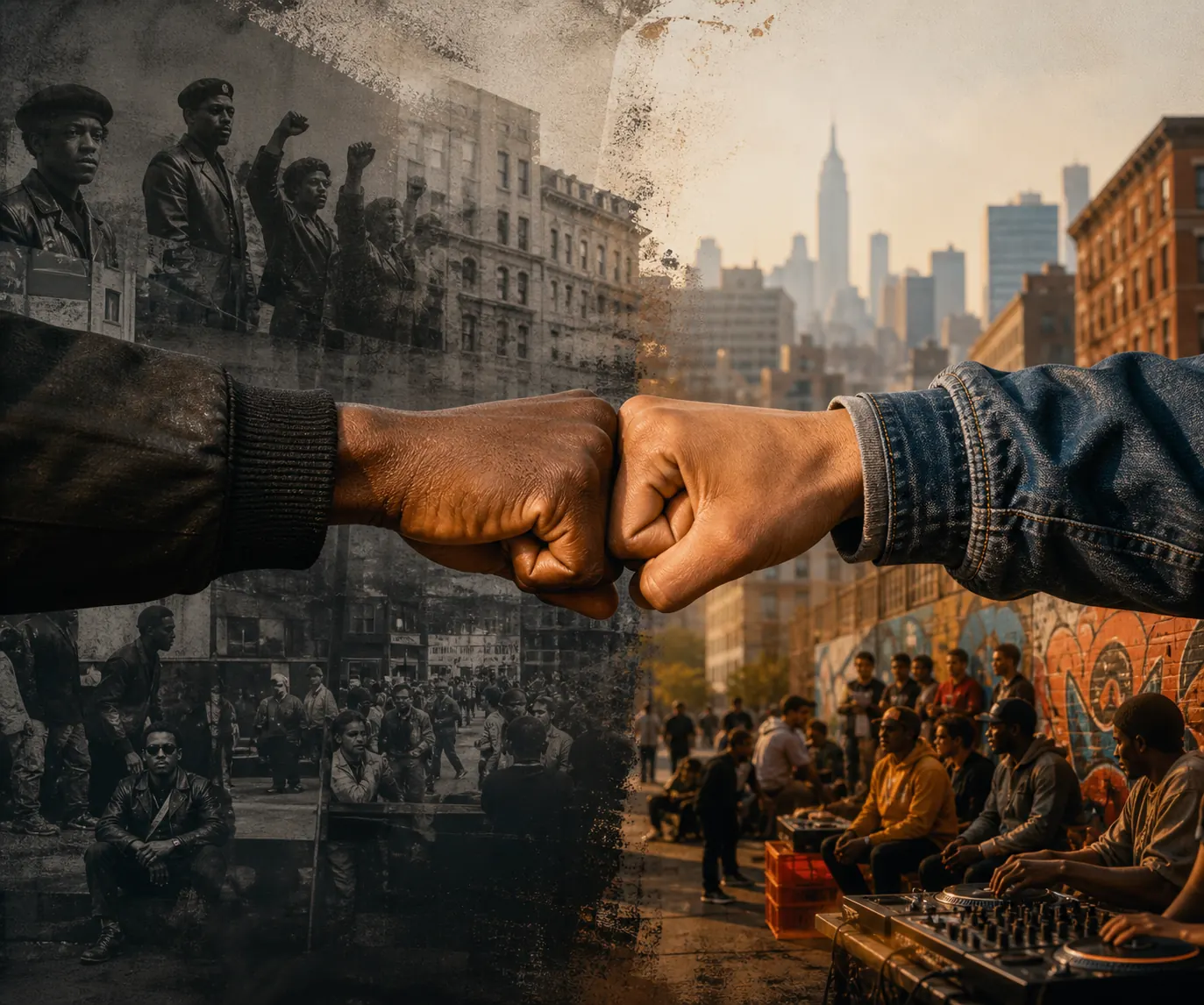
The check: from the secrecy of slaves to everyday banality (and Fox News conspiracy theories)
Eleven years ago already, people were still surprised that Barack Obama bumped fists with Michelle on the night of his election. Today, the “check” (fist bump, dap, pound, call it what you want) has become as natural as saying “hi.” We do it in the street, at the office, at the White House, and sometimes even with the baker if we forgot to take a ticket. But where does this gesture really come from? And why did it irritate some conservative media so much?
From chains to raised fists
The story begins far from TV sets. During slavery in the United States, slaves fleeing north (via the Underground Railroad) sometimes raised a fist as a sign of freedom. Used to having their wrists bound, this simple arm movement carried a strong symbolic charge. Later, in the 1960s, the raised fist became a gesture of solidarity against segregation. African American soldiers in Vietnam added variations: the “pound,” fists pressed against each other, like mutual comfort.
The most iconic moment remains 1968, at the Mexico City Olympics: Tommie Smith and John Carlos raise a black-gloved fist on the podium. A political gesture, not a buddies’ greeting. The check itself was popularized on the streets, through 1970s hip-hop. It was urban fraternity, an “we’re on the same side” without too many words.
Obama, cool, and conspiracy theories
November 2008. Obama wins. He greets Michelle with a fist bump. Two seconds. Fox News, in a burst of journalistic creativity, wonders whether it might be a “jihadist sign.” One laughs a little bitterly: the same media that sometimes struggles to tell a croissant from a butter croissant sees an Islamist threat here in a gesture born in the African American community. The ridicule speaks for itself.
Obama did not invent the check; he simply made it visible at the summit of the state. And he did not do it with everyone: rather with young people, Black people, children. Not necessarily with a 60-year-old white senator. Comedy Central mocked it, and rightly so. The gesture remains charged: “cool” with Obama, it would have been “politicized” (and probably criticized) with a Bush.
In France: more generational than racial
Here, the check caught on via hip-hop, globalization, and marketing (because selling sneakers works better with an “urban” gesture). It is mainly a matter of age. François Hollande could never have popularized it the same way: he was not identified with an oppressed culture. Here, it is a marker of “we belong to the same group,” not a heavy historical legacy.
Today, we do it almost without thinking. Sometimes we add a hug, sometimes it is just a bump of fists. The classic handshake still holds on, especially in more formal circles. But the real test, as a sociologist said at the time, would be the day a white woman elected in Washington did a check when introducing herself. We’re not quite there yet.
The check has not “supplanted” the handshake. It coexists, adapts, and sometimes becomes a caricature. It is a gesture born in pain and resistance, turned into a coolness accessory. Like many things in our era: we love symbols, as long as they do not force us too much to think about their origin.
(Test article – breakdown of an old subject that hasn’t aged a bit, or almost.)
Do you want me to adjust it (shorter, punchier, more factual, different tone) or shall we move on to integrating it on the site?

Profile
Georges Darmond
Journaliste politique mediasJe m'appelle Georges. Je suis née dans la région parisienne où j'exerce mon métier de journalisme depuis 1 an dans le domaine du de la politique, médias, social. Aujourd'hui, je m'intéresse tout particulièrement à aux promesses non tenues, aux fausses informations, aux affirmations douteuses qui influencent notre quotidien, nos espoirs et notre espérance dans le futur.
LinkedIn ↗