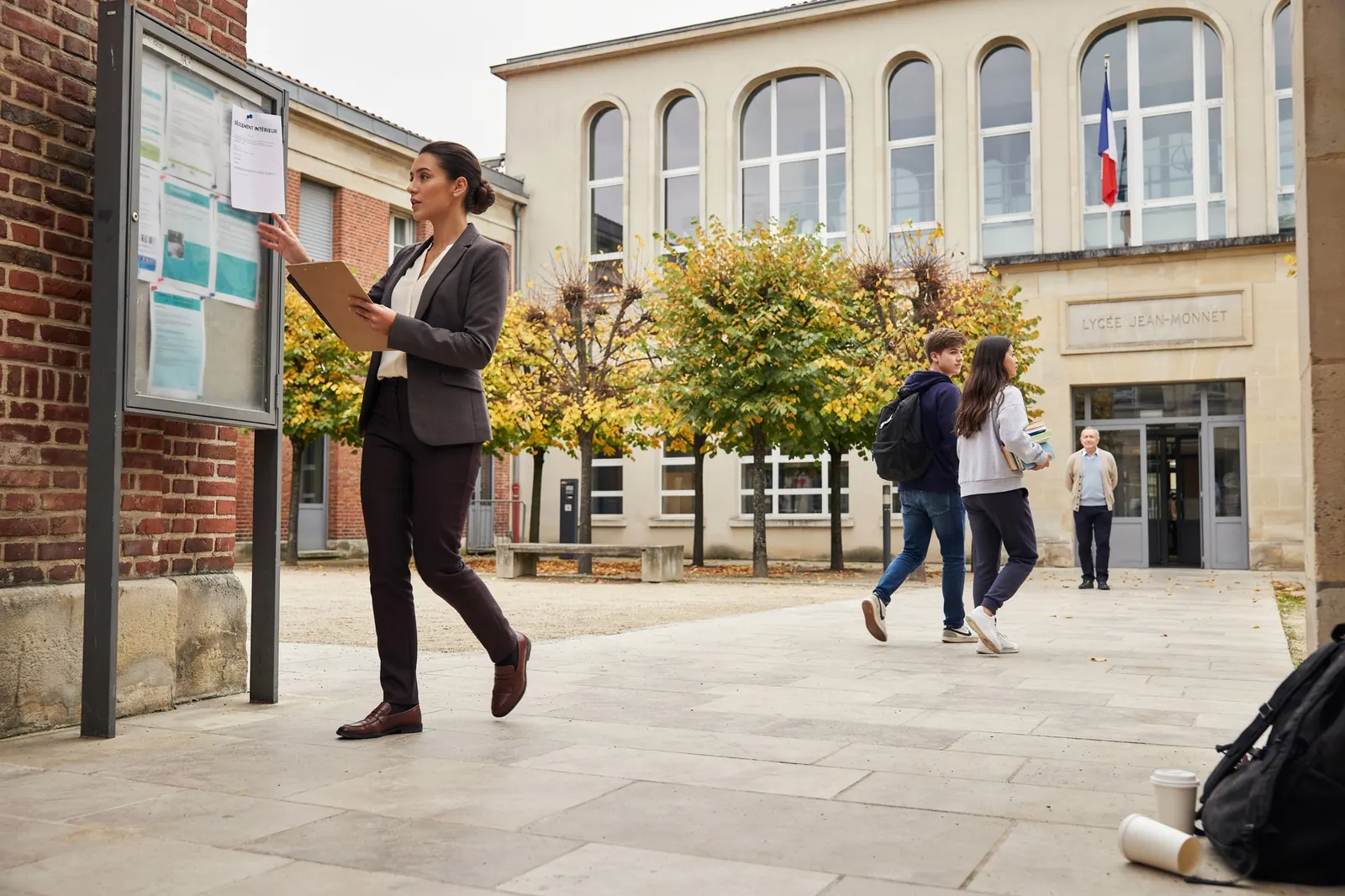
Why is this subject circulating now? A few days before the 2026-2027 school year, the website service-public.gouv.fr published on August 25, 2026 an updated fact sheet detailing the extension of the ban on the use of mobile phones and connected devices to high schools. This information follows the promulgation, the day before, of law No. 2026-813 of August 24, 2026 aimed at protecting minors from the risks associated with social networks. The measure was announced as applicable from the start of the school year by the government, prompting a strong media echo and reactions from school leadership staff.
Context and verifiable origin. Since law No. 2018-698 of August 3, 2018, article L. 511-5 of the education code prohibits the use by a pupil of a mobile phone or any other electronic communications terminal equipment in nursery schools, elementary schools and middle schools, as well as during outdoor teaching activities, subject to exceptions provided for by the internal rules (pedagogical uses in particular) or for medical reasons (disability or disabling health condition). For high schools, the 2018 text only left the option of banning via the internal rules. Several establishments had already done so on a voluntary basis. The new 2026 law amends the education code to establish the principle of a ban in high schools as well, ensuring continuity from nursery school to the baccalaureate. A circular from the Ministry of National Education dated July 2, 2026 and a handbook had anticipated this extension to prepare establishments. Official sources such as education.gouv.fr and info.gouv.fr confirm that the ban on use (not possession) applies from the 2026 back-to-school period in all establishments, during school time and related activities.
Established facts and sources. The service-public.gouv.fr fact sheet, issued by the Directorate of Legal and Administrative Information, faithfully reflects the framework: each high school must specify in its internal rules the arrangements for the ban (individual lockers, collective box, individual lockable pouch, phone switched off and put away, etc.). Exceptions remain possible for supervised pedagogical uses, CDI needs, catering, boarding, or a specific regime for higher education programs (BTS, preparatory classes). Confiscation or a graduated disciplinary sanction are provided for in the event of non-compliance, according to the rules of the regulations. The ministry indicates that around 28% of high schools already had an equivalent system before 2026. The law partially survived review by the Constitutional Council (decision of August 14, 2026), which invalidated other provisions on social networks, but left the school extension intact.
What is accurate, what remains to be nuanced or uncertain. The assertion examined is correct on the historical substance (ban since 2018 outside high school) and on the legal extension at the 2026 back-to-school period. It is not exaggerated. However, “ban” first means a ban on use, not necessarily on bringing the device; pupils can often keep it switched off. Immediate and uniform effectiveness is not guaranteed everywhere. Several unions of school heads (SNPDEN-Unsa in particular) and press reports (Le Parisien, Les Échos) highlight a “period of uncertainty”: amending the internal rules requires bodies (board of governors, CVL) whose elections take place after the start of the school year, which may delay full application until January 2027 or later in some cases. Costs (lockers, supervision) are mentioned, partly borne by the regions. The minister promised flexibility. Parent associations (FCPE) express reservations, pointing to the paradox with the use of Pronote or digital tools. There is no evidence of an absolute ban without exception; the framework remains flexible and local.
Contradictions and blind spots. Official discourse stresses a “phone-free school” to improve the school climate, concentration and reduce cyberbullying, drawing on the 2024 report of the “Children and screens” commission. On the ground, application already varies and will remain heterogeneous. The real impact on learning and well-being has not yet been measured on a national scale for high schools. Adult pupils in post-baccalaureate sections benefit from possible flexibility. The precise arrangements for monitoring and sanctions remain to be defined locally, which may create inequalities between establishments. The service-public information is up to date as of August 25, 2026 and is based on the law and the circular; it does not claim to resolve logistical questions.
Provisional conclusion. On the basis of official texts (law of August 24, 2026, amended article L. 511-5, ministerial circular and handbook) and confirmations from credible press and government websites, the extension of the ban on the use of mobile phones to high schools from the 2026 back-to-school period is an established fact. The arrangements for application are deliberately decentralized and leave a wide margin to establishments. Practical implementation encounters documented organizational and financial obstacles, which leaves open questions about homogeneity and the exact timetable in all high schools. The verdict on the long-term effectiveness of the measure will remain to be assessed after several months of application.

Profile
Georges Darmond
Journaliste politique mediasJe m'appelle Georges. Je suis née dans la région parisienne où j'exerce mon métier de journalisme depuis 1 an dans le domaine du de la politique, médias, social. Aujourd'hui, je m'intéresse tout particulièrement à aux promesses non tenues, aux fausses informations, aux affirmations douteuses qui influencent notre quotidien, nos espoirs et notre espérance dans le futur.
LinkedIn ↗