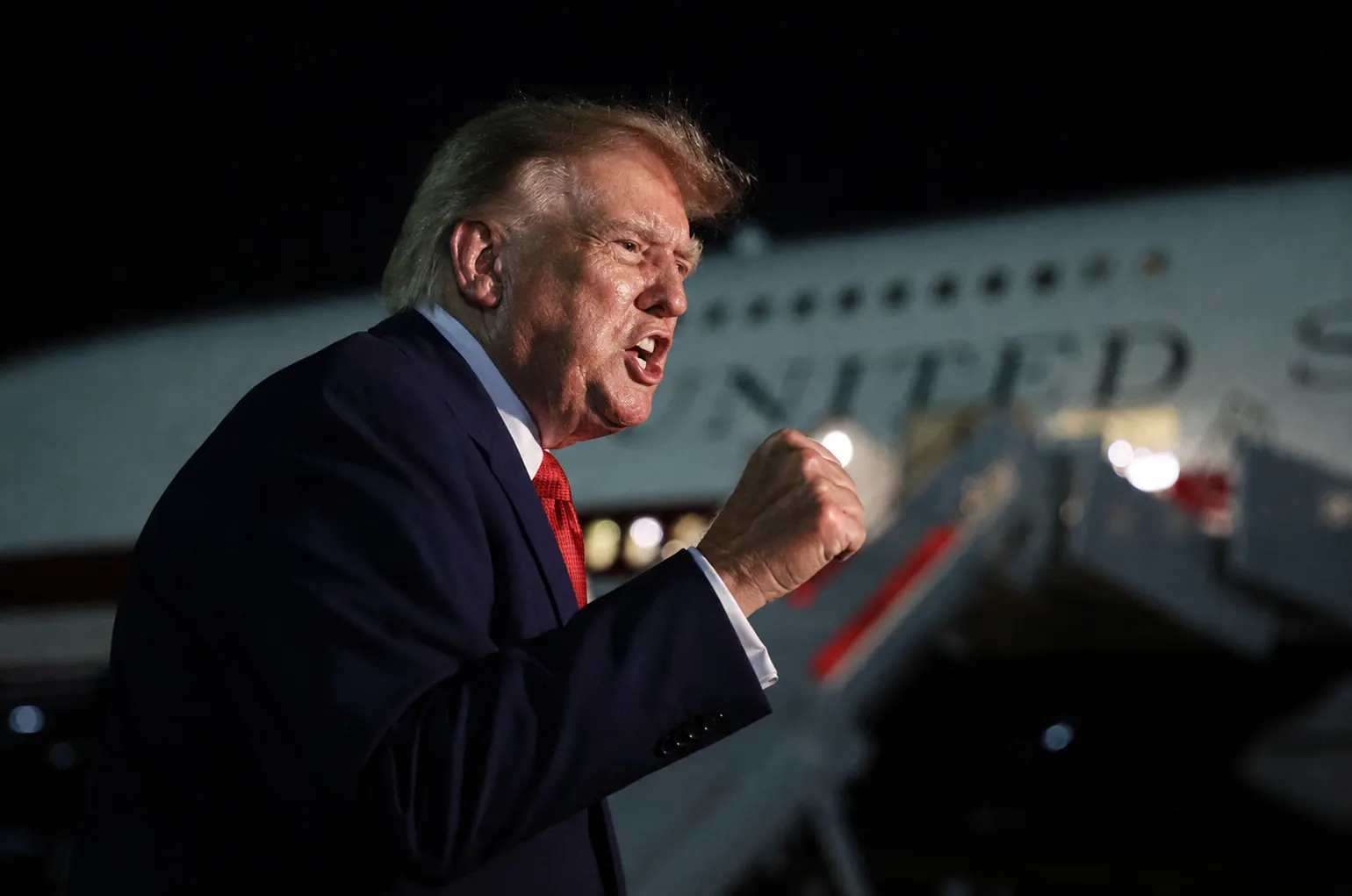
On August 24, 2026, as negotiations to end the conflict in the Middle East stalled, Donald Trump posted on Truth Social a terse formula in capital letters: Iran is "completely collapsing." A few hours later, Treasury Secretary Scott Bessent detailed the operation dubbed "Economic Outcast" (or "economic D-Day"), presented as the most extensive economic isolation campaign ever mounted against an adversary. The stated objective is to cut off "all economic resources" and "every lifeline" of the regime, notably by targeting digital assets, technology, gold, aviation and shipping, sanctioning some sixty entities, individuals and vessels, and threatening secondary sanctions against countries and companies that continue to trade with Tehran, up to exclusion from the dollar system. BFM, Le Figaro, RFI, La Presse and other media picked up the presidential formula and the context of the new measures. Le Monde, for its part, headlined on "the slow collapse of purchasing power" in Iran.
Why is this circulating now? Six months after the start of the Israeli-American strikes (around late February-early March 2026 according to chronologies) and amid a naval blockade limiting Iranian oil exports, Washington is seeking a non-military lever to force Tehran to yield. Oil exports are said to have fallen from about 2 million barrels per day before the conflict to about 0.4 million in mid-August 2026 according to maritime tracking data such as Kpler. Trump and Bessent present the economic pressure as the "endgame" after the strikes that are said to have weakened Iran's military and nuclear capabilities.
Established facts on the Iranian economy. The crisis is not new: long-standing US and international sanctions, mismanagement, corruption and external shocks. It has clearly worsened. The rial has reached record levels of weakness on the parallel market: around 2 million rials (or more than 200,000 tomans) to one US dollar in late August 2026 according to several tracking sites and reports. Inflation exceeded 40-50% in 2025 (48.6% in October, 42.2% in December according to sources) and the IMF forecasts still very high levels in 2026, up to nearly 69% in some estimates, with a real GDP contraction on the order of 5 to 6%. Food prices have soared, poverty has increased (estimates ranging from 22% to 50% of the population below the threshold), households are drastically cutting consumption, fruit, protein and leisure. Queues and occasional shortages (fuel) have been observed. In late 2025-early 2026, massive cost-of-living protests were harshly repressed, with death tolls in the thousands according to NGOs. Purchasing power is eroding lastingly, as documented by Le Monde.
What is false, exaggerated or uncertain. The claim of a "complete collapse" is a political hyperbole by Trump, not a neutral observation. The economy is in a severe crisis, even in freefall on some monetary and social indicators, but the regime has not collapsed: the security apparatus, networks linked to the Revolutionary Guards and adaptation circuits (trade via China, which still buys a significant share of Iranian oil despite the declines, gold, cryptos, workarounds) continue to function. Analysts (Atlantic Council, Arab Center, etc.) stress that past sanctions, even massive ones, have not brought about the fall of the regime; they hit the population first and can strengthen the control of state and security networks. Bessent himself has at times described the measures as a "warning shot." The effectiveness of the new secondary sanctions, especially vis-à-vis China and other partners, remains to be demonstrated: Beijing has already signaled that it would protect its interests. Tehran has rejected the threats as an American "admission of defeat," claimed to be prepared with a "two-year plan," and threatened "seismic" responses or to regard as enemies countries that join the pressure.
Contradictions and blind spots. Trump proclaims the collapse already underway while launching an offensive to provoke or accelerate it: this is maximum-pressure communication more than a stabilized factual diagnosis. Official US sources (White House, Treasury) highlight the prior military success and the total isolation sought; field reporting and macro data (IMF, exchange-rate trackers) confirm the economic and social suffering but not the disappearance of power. Blind spots include the exact scale of war damage to infrastructure, the precise role of the Strait of Hormuz, the medium-term humanitarian impact, the real capacity to enforce secondary sanctions without a rift with allies or China, and the evolution of internal protests under repression. Figures for oil exports, inflation and exchange rates vary by source (official Iranian vs. parallel market vs. Western analysts) and must be read with caution.
Provisional conclusion. Trump's statement picks up a partially founded observation about an Iranian economy severely weakened by years of sanctions, an ongoing war, a blockade and a plunge in the rial that is crushing purchasing power. The new sanctions of August 24, 2026 constitute a real escalation aimed at maximum isolation. By contrast, speaking of a "complete collapse" of Iran (state or regime) goes beyond the available evidence: the crisis is deep and documented, the regime shows signs of resilience and repression, and the outcome (capitulation, hardening, prolonged humanitarian crisis or other) remains open. The coming months, with monitoring of oil flows, the exchange rate, Chinese reactions and the social situation, will make it possible to refine the diagnosis. Primary sources (White House/Treasury communiqués, Iranian statements, IMF data and cross-checked field reporting) remain the most reliable in the face of spectacular political formulas.

Profile
Georges Darmond
Journaliste politique mediasJe m'appelle Georges. Je suis née dans la région parisienne où j'exerce mon métier de journalisme depuis 1 an dans le domaine du de la politique, médias, social. Aujourd'hui, je m'intéresse tout particulièrement à aux promesses non tenues, aux fausses informations, aux affirmations douteuses qui influencent notre quotidien, nos espoirs et notre espérance dans le futur.
LinkedIn ↗