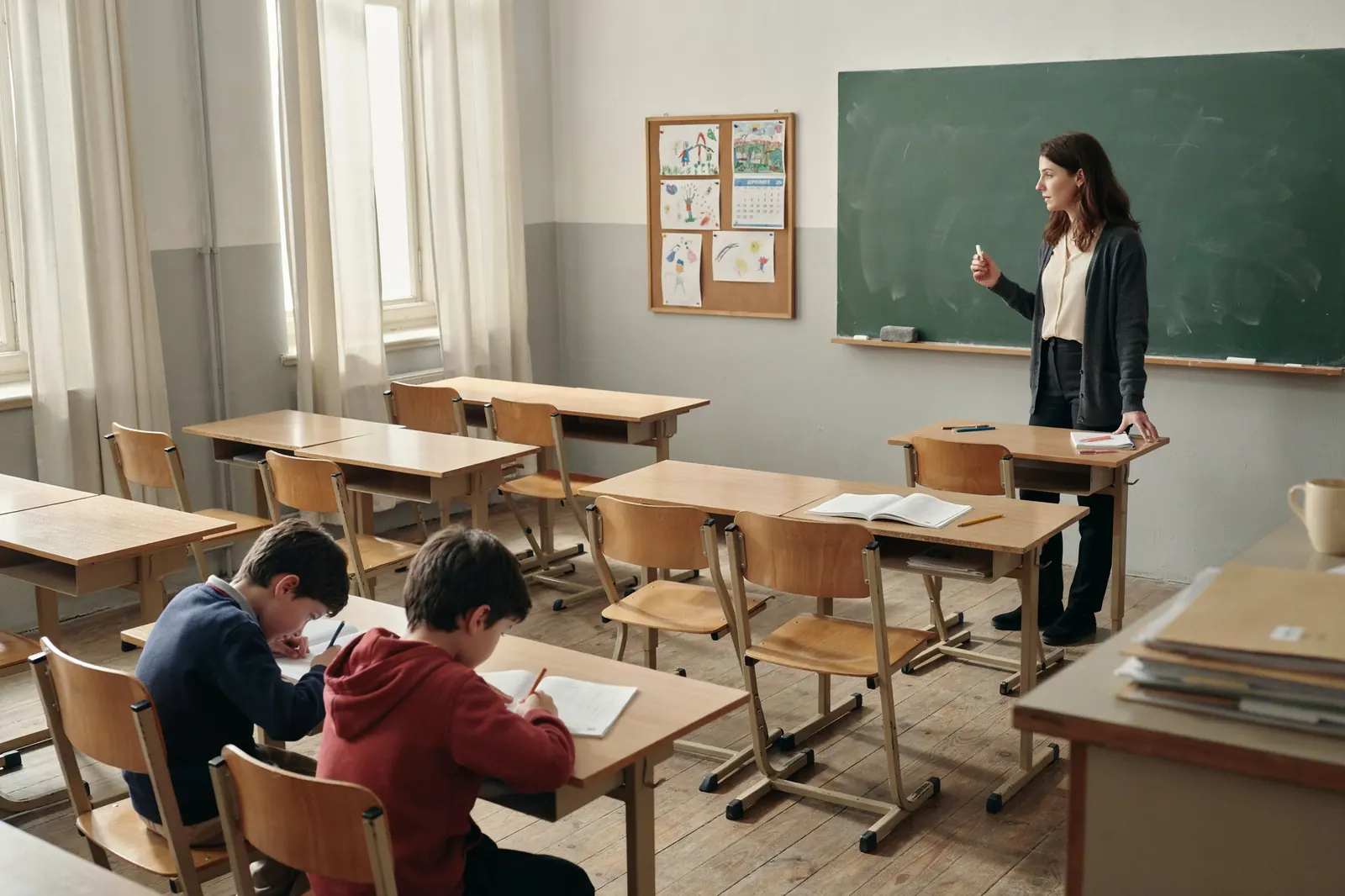
Eleven million six hundred thousand schoolbags. Roughly. This back-to-school Tuesday in 2026, 11,607,600 primary, middle and high school pupils are heading back to class. That is already 160,000 fewer than last year. The ministry displays the figure without flinching. What follows promises to be even drier still.
Le Monde, in an editorial of August 31, sets the scene with panache: “Demographic decline at school: a historic opportunity to debate.” By 2035, it asserts, drawing on DEPP projections, there will be 1.7 million fewer pupils, or about 14%. Strong territorial disparities. Private education that could climb to as much as half of enrollments if care is not taken. And 16 billion euros in “redeployable” spending, 1 to 2 billion a year, according to the Institut Montaigne. A fine promise. One might think one was hearing the waiter announce the dish of the day before the kitchen had even opened.[[1]](https://www.lemonde.fr/idees/article/2026/08/31/baisse-demographique-a-l-ecole-une-opportunite-historique-a-debattre67622453232.html)
The facts, first. In April 2026, the ministry published for the first time ten-year departmental projections. Reference scenario: 1,676,800 fewer pupils by 2035 in the public sector and private schools under contract. Primary education takes the biggest hit, 933,000 fewer pupils. Secondary follows with 743,800. Main cause: the collapse in the birth rate. 645,000 births in 2025, 24% fewer than in 2010. As of this back-to-school period, more than 160,000 fewer pupils, especially in nursery school where the 2023 generation arrives lighter. The figures match. We do not invent them. We endure them.[[2]](https://www.education.gouv.fr/demographie-scolaire-le-ministere-publie-pour-la-premiere-fois-des-projections-d-effectifs-d-eleves-504392)
In the Var, the academic directorate has the good grace of frankness. “We could have closed 40 classes!” the Dasen lets slip. We settled for a net balance of nine closures for 1,175 fewer pupils in primary education. Stated objective: to lower the pupil-teacher ratio just a tiny bit, from 22.27 to 22.20 pupils per class. Nationally, it is close to 21 in primary. That is better than the fat years. It is not yet the open sea. The unions, for their part, mainly see the posts disappearing and the averages that mask classes of 28 or 30. Reality has a sense of wry humor.[[3]](https://www.nicematin.com/societe/education/pres-de-1-200-eleves-en-moins-dans-le-var-neuf-classes-fermees-pour-la-rentree-2026-10685067)
The buzz, meanwhile, oscillates between two postures. On one side, the historic windfall: lighten the classes, revalue teachers who can take no more, correct inequalities. Opinion pieces, think tanks, presidential candidates see a bonanza in it. On the other, the accounting temptation. Fewer pupils, fewer posts, lighter debts. We have already seen the movie. Thousands of job cuts announced earlier in the year caused grinding of teeth. The year 2026-2027, says Le Monde, must serve for the great debate. We are still waiting for the date of the first session. The opportunity has the flaw of last-minute invitations: everyone says yes, no one has reserved the room.
The blind spots are not lacking. The projections remain scenarios. They depend on future birth rates, migrations, families’ choices toward the private sector. The 16 billion “redeployable” are a think-tank estimate taken up by the editorial; we do not have the detail of the public calculation before our eyes. The territorial disparities are dizzying: Paris could lose nearly 30% in primary, other departments far less. Closing a village school is not just a figure. It is a public service evaporating. And meanwhile, a cyberattack has again scrambled the start of term in a few academies. The logistics, for their part, do not wait for the philosophical debate.
Provisional conclusion: the decline is real, massive, already here. The opportunity is too, on paper. But an opportunity not seized strongly resembles a disguised saving. The facts are solid. The political course remains fuzzy. We smile seeing the communiqués promise the historic. We smile less wondering who, concretely, will pay the bill or reap the dividend. The school has lost pupils. It has not yet found its breath. To be continued, without illusion or pathos.

Profile
Georges Darmond
Journaliste politique mediasJe m'appelle Georges. Je suis née dans la région parisienne où j'exerce mon métier de journalisme depuis 1 an dans le domaine du de la politique, médias, social. Aujourd'hui, je m'intéresse tout particulièrement à aux promesses non tenues, aux fausses informations, aux affirmations douteuses qui influencent notre quotidien, nos espoirs et notre espérance dans le futur.
LinkedIn ↗