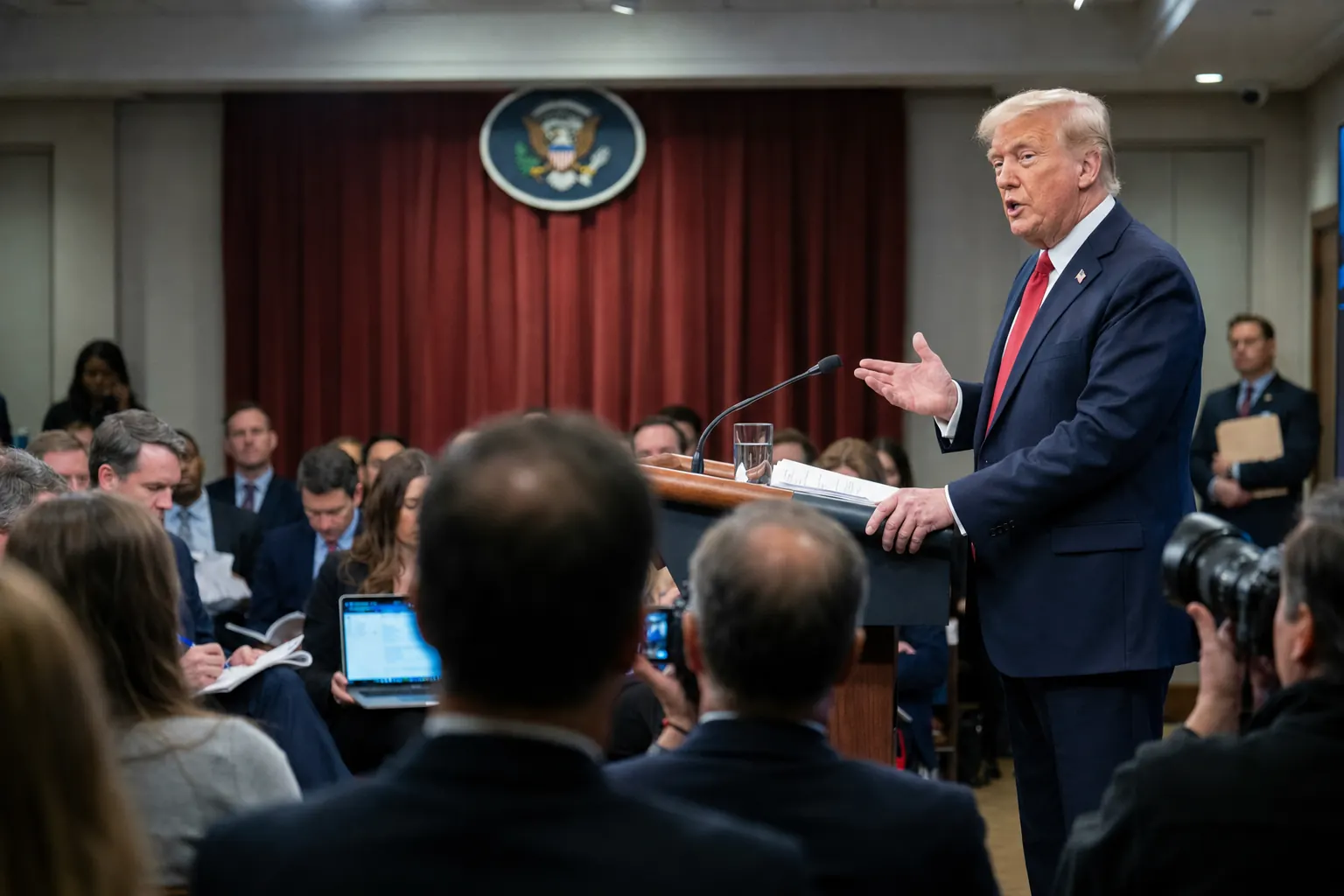
On February 28, 2026, Donald Trump announced on Truth Social a "massive" operation dubbed Epic Fury, hand in hand with Israel and its Roaring Lion. Supreme Leader Ali Khamenei lost his life in it. Almost six months later to the day, the same Trump asserts that Iran is "completely collapsing." Tehran politely replies that it is rather an admission of American defeat. Between the two versions, there is a Strait of Hormuz that is coughing, oil that has soared, and midterms approaching fast. That is the scene set by franceinfo on August 29. And, for once, the buzz does not entirely come out of nowhere.
The established facts hold up. The war started on February 28 with joint strikes. A memorandum of understanding was signed in mid-June, to calm things down and reopen the strait a little. It fell apart. Negotiations are stalling. Maritime disruptions drag on. And the administration is conspicuously shifting toward economic pressure. Scott Bessent, Treasury secretary, brandished his "economic D-Day" or "Operation Economic Outcast": expanded secondary sanctions, targeted sectors (gold, crypto, aviation, shipping), threat to cut off from the dollar anyone still helping Tehran. Trump posts in capital letters that Iran is collapsing. The timing? Two months before the November 2026 midterms. Coincidence, of course.
One might smile at the phrase "exit door." Trump never said "I'm out of here." He says rather: we broke their army, now we cut off their supplies, and the regime will fall on its own. Experts consulted by the press note the disconnect. Iranian military capabilities heavily damaged, yes. Initial decapitation successful, yes. But the regime holds, even radicalizes according to some, and the nuclear program is not wiped off the map. The Strait of Hormuz remains the thorn: Tehran uses it as leverage, Washington claims to control it. Meanwhile, the American gallon of gas has climbed, Trump's approval has slipped toward 33%, and Republicans look at their polls the way one looks at a thermometer in the middle of a flu. The war is not popular. The cost of living even less so.
There is exaggeration in the air. Trump had promised a matter of a few weeks. We are at six months of a fragile "in-between," with punctual strikes and reciprocal threats. Iran is "completely collapsing"? That is the White House version. On the other side, people talk of an admission of American failure and of the regime's survival. Primary sources—official statements, Centcom reports, institute analyses—show real damage on the Iranian side, but not the total collapse announced on a loop. The figures for destroyed factories or missiles vary depending on who puts them out. As for the "exit door," it looks more like a change of strategy under electoral pressure: fewer visible bombs, more sanctions that make less noise with the American voter… as long as oil does not flare up again.
The blind spots? It is still unknown whether this economic turn will hold up against workarounds (China, etc.) and retaliations. Talks via Oman or Pakistan exist, but each side sticks to its conditions. Trump denies that the midterms influence his line; his Republican allies, for their part, sense the wind. And the second term that ends in 2029 is not waiting patiently for the Middle East to fall into line. Franceinfo correctly sets the framework. It does not invent the shift toward the economic nor the electoral calendar. It recounts it with the tone of deadlock. What is a bit off is the implicit promise of a clean "exit." For now, what we mainly see is a president who changes weapons without leaving the battlefield.
Provisional conclusion, then: franceinfo's statement holds on the main facts. War launched six months ago, shift toward economic pressure, midterms in two months, second term at stake. The rest—Iranian collapse, miraculous exit door—belongs to communications discourse and electoral hope. Trump is looking for a way out that lets him say "I won" without sending planes back every night. Iran is looking to hold on. American voters, for their part, are watching the price at the pump. And the Middle East, as always, refuses to bend to Washington's calendar. We leave with a tight smile: six months to turn an "epic fury" into an economic day. It took some nerve.

Profile
Georges Darmond
Journaliste politique mediasJe m'appelle Georges. Je suis née dans la région parisienne où j'exerce mon métier de journalisme depuis 1 an dans le domaine du de la politique, médias, social. Aujourd'hui, je m'intéresse tout particulièrement à aux promesses non tenues, aux fausses informations, aux affirmations douteuses qui influencent notre quotidien, nos espoirs et notre espérance dans le futur.
LinkedIn ↗