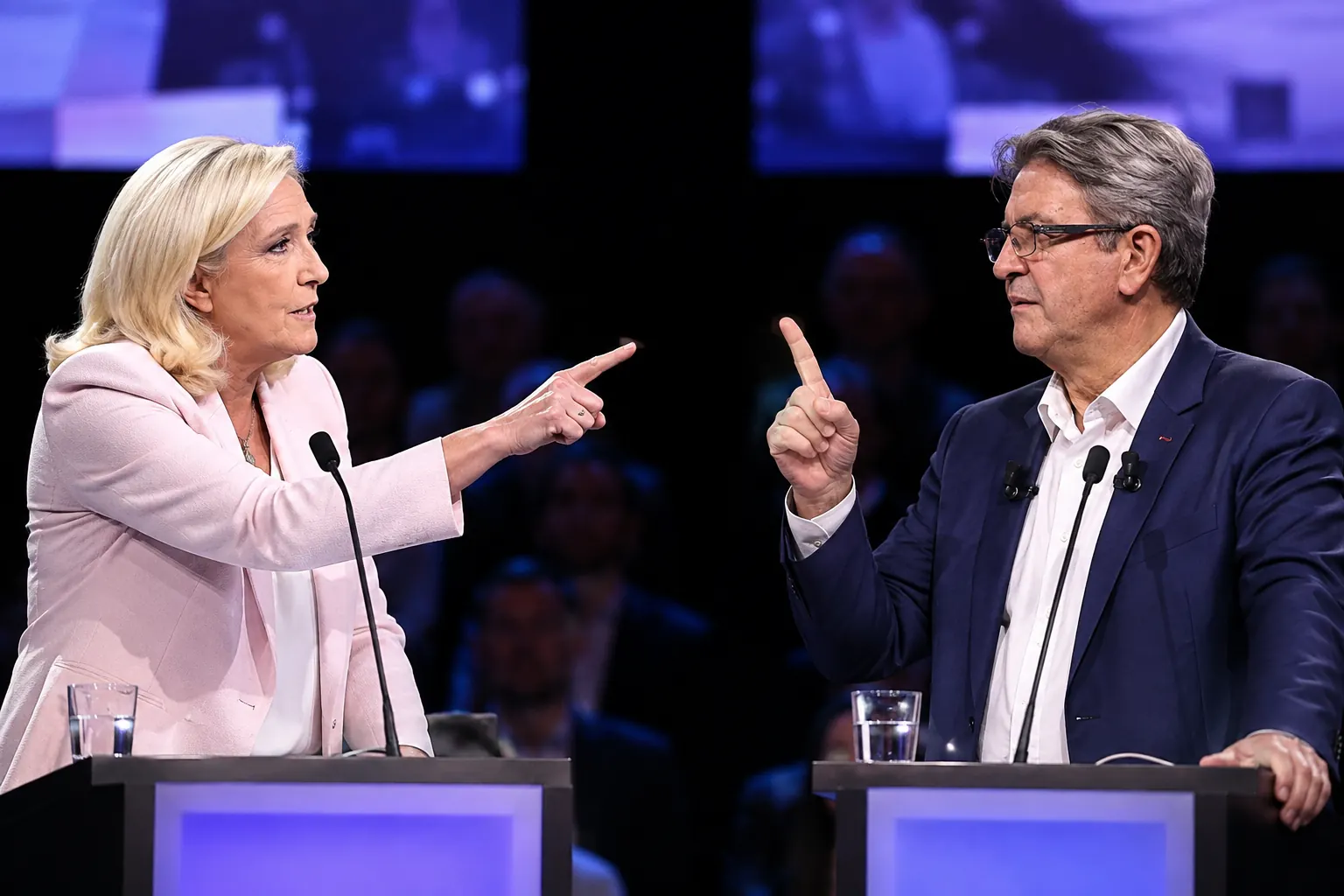
The media buzz of August 24, 2026 around a possible Marine Le Pen-Jean-Luc Mélenchon runoff in the 2027 presidential election is based on a concrete and verifiable poll. RTL published that day the results of a Toluna Harris Interactive barometer conducted for M6 and RTL. The pickups in Le Parisien, Sud Ouest, i24NEWS, La Dépêche or Le Figaro essentially reiterate the same findings, sometimes with more punchy wording.
Context and origin. With less than a year to go before the election (first round scheduled for April 2027), the campaign is accelerating. Jean-Luc Mélenchon stated at the LFI summer university that "victory is possible." Raphaël Glucksmann officially announced his candidacy on August 23 on the TF1 evening news and said he would take part in a left-wing primary in October. Yannick Jadot immediately threw his support behind Glucksmann. Marine Le Pen, convicted on appeal in the parliamentary assistants case but still a candidate and having appealed to the Court of Cassation, remains the dominant figure of the National Rally. It is in this climate that the monthly Toluna Harris Interactive barometer was released.
Established facts from the poll. The survey was conducted online on August 18 and 19, 2026 among a sample of 1,764 people registered on the electoral rolls (drawn from a larger sample representative of those aged 18 and over), using the quota method and standard adjustments (gender, age, socio-professional category, region, past votes). Five first-round hypotheses were tested.
In all configurations, Marine Le Pen comes out clearly ahead, credited with 35 to 38% of voting intentions. She continues the rise observed since the confirmation of her candidacy in July. Jean-Luc Mélenchon is credited with 16 to 17% depending on the scenarios. He places second or in a qualifying position in several cases: notably when Édouard Philippe and Gabriel Attal are both candidates (Mélenchon at 16%, Philippe at 14%, Attal at 8%). In the event of a single centrist candidacy facing Glucksmann (10-11%), Mélenchon ties with Philippe (17%) or outpaces Attal. Only the hypothesis of a François Hollande candidacy (8%) sees him overtaken by Philippe (19%), while remaining solid at 17%. Bruno Retailleau stagnates between 6 and 9%, Marine Tondelier between 2 and 5%, Fabien Roussel between 2 and 3%, Éric Zemmour between 3 and 4%.
In the second round, the hypotheses tested (confirmed by pickups and posts detailing the figures) have Marine Le Pen winning handily against Mélenchon (around 68% to 32%), as well as against Attal (57-43%) or Philippe (55-45%). These orders of magnitude are consistent with previous waves from the same institute (July: Le Pen at 67% against Mélenchon) and with other pollsters (Elabe, Ifop) that already placed Le Pen between 67 and 70% against the Insoumis leader.
What is accurate, exaggerated or still uncertain. The statement "the RN candidate clearly ahead" is accurate and solidly backed by this poll as by most recent surveys. "The Insoumis leader better placed than ever for the second round" matches the observed dynamic: Mélenchon is progressing compared with the spring-summer waves (around 12-15% previously) and benefits from the fragmentation of the center and the left. Headlines talking about a "Le Pen-Mélenchon duel" describe a real possibility under certain hypotheses (especially an Attal-Philippe split), not a certainty. It is not the only possible scenario: a Le Pen-Philippe runoff remains competitive if the center unites.
The formulations "surges," "strong progress" or "can reach" are journalistic and proportionate to the figures, even if the gap with Glucksmann (10-11%) remains clear and the left remains divided. No invention of major figures appears in the RTL, Le Parisien or i24NEWS headlines examined. On the other hand, presenting the duel as a done deal ignores the volatility eight months before the vote and the fact that second-round intentions remain highly hypothetical, with a significant share of abstention, blank or null votes reported in previous waves (22 to 34%).
Contradictions and blind spots. Other institutes (Elabe for BFMTV, Ifop for Le Figaro/LCI in July) already showed very similar trends: Le Pen dominant at 34-36%, Mélenchon the best placed on the left around 15-16%, and a wide Le Pen victory in the second round against him. No frontal contradiction. Blind spots: the poll does not test all possible candidacies (for example a single left-wing candidate or other figures), rests on hypotheses of candidates remaining in the race, and comes before the October left-wing primary and possible consolidations in the center. The margins of error (generally on the order of 2-3 points for such a sample) and the declarative nature of the intentions limit the predictive scope. Historically, Mélenchon has sometimes been underestimated at the end of the campaign, while second rounds against the RN have seen complex vote transfers and variable republican fronts. Le Pen's conviction and her appeal have not for now slowed her momentum in the surveys, but the real effect on the ground remains to be measured.
Provisional conclusion. The RTL/Toluna Harris Interactive poll of August 2026 does confirm that Marine Le Pen is very clearly ahead in voting intentions and that Jean-Luc Mélenchon is, at this stage, better placed than in previous measurements to aim for a second-round qualification, especially if the center splits. A Le Pen-Mélenchon duel is a credible scenario among others, and Le Pen is widely projected to win it. These elements are measured opinion facts at a given moment T, not a result prediction. Eight months before the vote, with candidacies still fluid and strong uncertainty over vote transfers and turnout, the verdict of the ballot box remains open. Upcoming barometers, notably after the left-wing primary and possible rallies, will make it possible to judge whether the dynamic is confirmed.

Profile
Georges Darmond
Journaliste politique mediasJe m'appelle Georges. Je suis née dans la région parisienne où j'exerce mon métier de journalisme depuis 1 an dans le domaine du de la politique, médias, social. Aujourd'hui, je m'intéresse tout particulièrement à aux promesses non tenues, aux fausses informations, aux affirmations douteuses qui influencent notre quotidien, nos espoirs et notre espérance dans le futur.
LinkedIn ↗