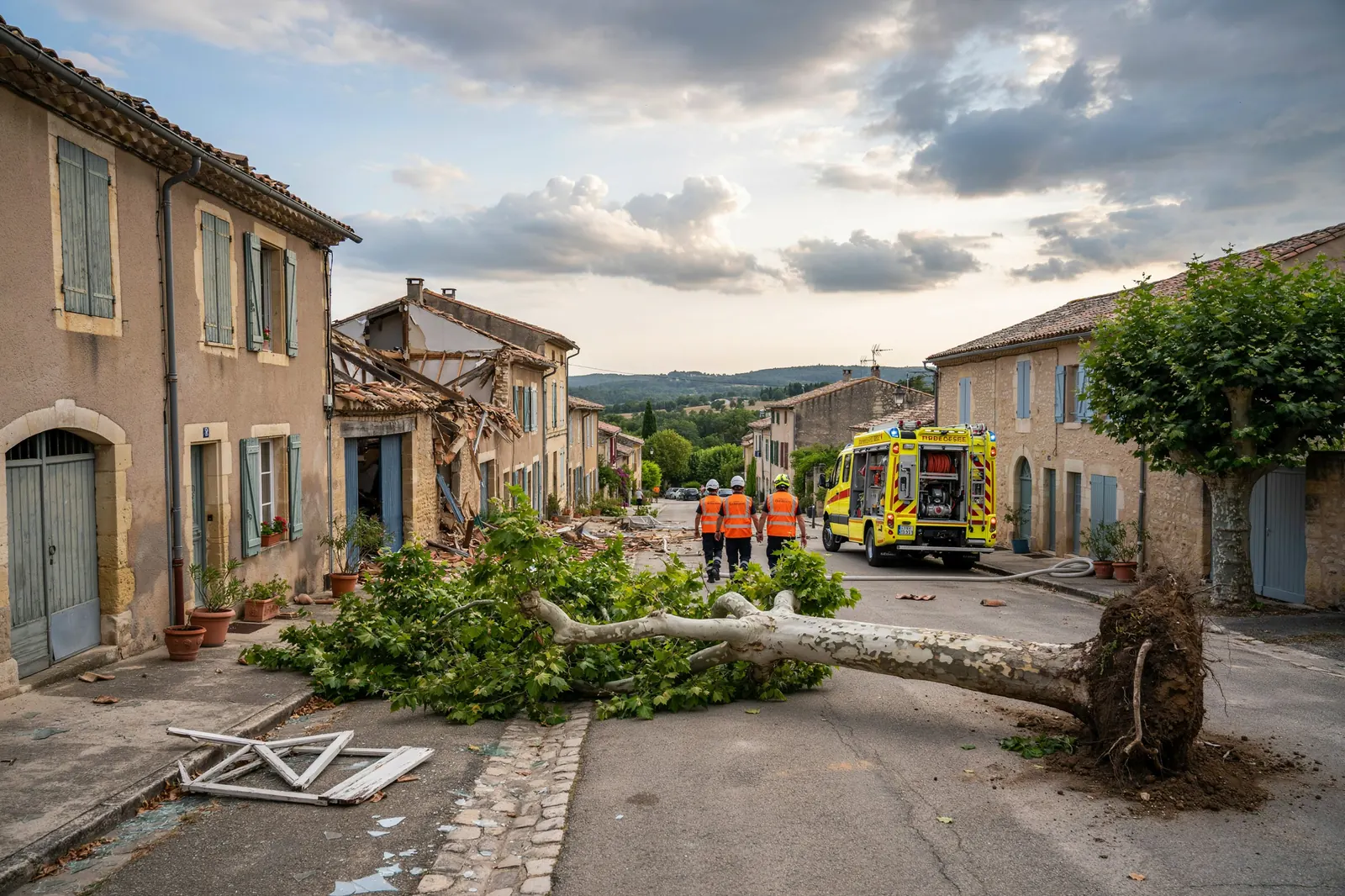
On August 24, 2026 in the late afternoon, while the Aude was under an orange thunderstorm warning, a supercell generated a tornado that crossed the village of Pomas, a municipality of about 1,000 inhabitants located south of Carcassonne. The event immediately circulated via videos of an impressive whirlwind and testimonies of stunned shock. The franceinfo article from the same day headlined with the phrase "Half the village is destroyed" attributed to Pierre, a resident of the neighboring municipality of Rouffiac, speaking to ICI Occitanie, and mentioned around a hundred firefighters mobilized as well as dozens of injured people.
Established facts and primary sources. The Aude prefecture confirmed the phenomenon as early as the evening of August 24. Evolving provisional human toll: first 41 people treated, then consolidated around 39 injured (including about fifteen to twenty hospitalized), with at one point two people in absolute emergency who were no longer in that condition the next day. Later assessments mentioned up to around fifty people who had gone through the emergency centers. No deaths or missing persons were reported. Mayor Hervé Giné described the absence of fatalities as a "miracle," estimating that there could have been dozens of victims. A pregnant woman was injured in the collapse of her house. More than 120 firefighters (figures varying from 75 to 157 depending on the situation updates, with reinforcements from other departments) were deployed, supported by debris clearance specialists, a dog unit, gendarmes and the Red Cross. Shelters opened at the multipurpose hall in Pomas and in Limoux. Thousands of households (up to 2,800 initially in the area) were without electricity.
On the material side, the prefecture initially reported approximately 300 homes impacted (mainly roofs and tiles torn off, with "two or three buildings razed"). Later assessments specified 330 houses affected out of the 476 to 496 in the municipality. Among the homes already assessed (nearly 300), about 102 were deemed completely destroyed or uninhabitable, roughly one house in five. The school, the town hall, the grocery store, the post office and part of the castle were also heavily damaged. The Keraunos observatory confirmed that it was indeed a tornado from a supercell, with an estimated intensity between EF2 and EF3 (winds probably exceeding 200 km/h, possibly 220-270 km/h according to initial field analyses and experts such as Pierre Mahieu). Gusts of 117 km/h had been measured about twenty kilometers away. Météo-France had anticipated local whirlwind phenomena in its warning.
Origin of the testimony and its circulation. The exact phrase "Half the village is destroyed" is indeed that of Pierre (winegrower at the Château de Gaure estate in Rouffiac-d’Aude), who described seeing "an enormous red, yellow chimney" with flying debris while returning from Carcassonne. He also mentioned that a third of the castle had fallen. This testimony was picked up by ICI Occitanie, franceinfo, France 3 and other media. It is a hot reaction from a local resident, not an official count. Aerial images and on-site reports (roofs blown off, gutted houses, overturned cars, streets littered with rubble) reinforced the sense of massive devastation, especially in certain "swept" housing estates.
What is accurate, exaggerated or still uncertain. The event is fully confirmed by the prefecture, emergency services, Keraunos, multiple regional and national press reports (La Dépêche, Midi Libre, Le Monde, Le Parisien, BFMTV, etc.) and images. "Dozens of injured" matches the tolls (39 to around fifty). The mobilization of around a hundred firefighters (or more) is accurate. However, "half the village is destroyed" is an approximate and visual formulation. About 60-70% of the houses were affected to varying degrees, but total destruction concerns rather 20% of the assessed stock. Saying that the village is "almost destroyed" or "partially destroyed" (formulas used by some headlines) better captures the nuanced reality: considerable and traumatic damage, but not complete annihilation. The exact intensity on the Enhanced Fujita scale remains under detailed evaluation through field investigation. No evidence of people buried and not found held up; rumors of missing persons were denied. The human and material tolls evolved over 24-48 hours, which is classic in this type of disaster.
Contradictions and blind spots. The figures for houses (300, 330, 300 out of 476/500) and injured vary slightly depending on the time of the situation update and the sources, which is normal in the emergency phase. Some headlines spoke of an "almost destroyed village" or "300 houses destroyed" while many were only partially damaged (roofs). The mayor insisted on the shock and the need to rebuild, while highlighting the human miracle. The school will not be able to welcome pupils at the start of the school year on September 1 and will be temporarily relocated. Little detailed public information yet on the total cost of the damage or the definitive classification of all homes. The weather context (hot summer, warm Mediterranean favoring convective energy) is mentioned by experts, without it being possible to attribute this isolated event solely to climate change.
Provisional conclusion. The essence of the verified statement is well-founded: a real tornado, rare in its intensity, struck Pomas on August 24, 2026, injured dozens of people (consolidated toll around 39-50) and severely damaged a large part of the village (approximately 300 homes affected, more than 100 completely destroyed). The testimony "half the village is destroyed" is an understandable hyperbole from a local resident that corresponds to the order of magnitude of the impacted houses, even if it does not exactly match the official counts of total destructions. No element contradicts the reality of the disaster. Securing, assessment and rehousing operations continued in the following days. The toll remains provisional on the fine material details and the definitive intensity, but the central facts are solidly established by the authorities and independent sources.

Profile
Georges Darmond
Journaliste politique mediasJe m'appelle Georges. Je suis née dans la région parisienne où j'exerce mon métier de journalisme depuis 1 an dans le domaine du de la politique, médias, social. Aujourd'hui, je m'intéresse tout particulièrement à aux promesses non tenues, aux fausses informations, aux affirmations douteuses qui influencent notre quotidien, nos espoirs et notre espérance dans le futur.
LinkedIn ↗