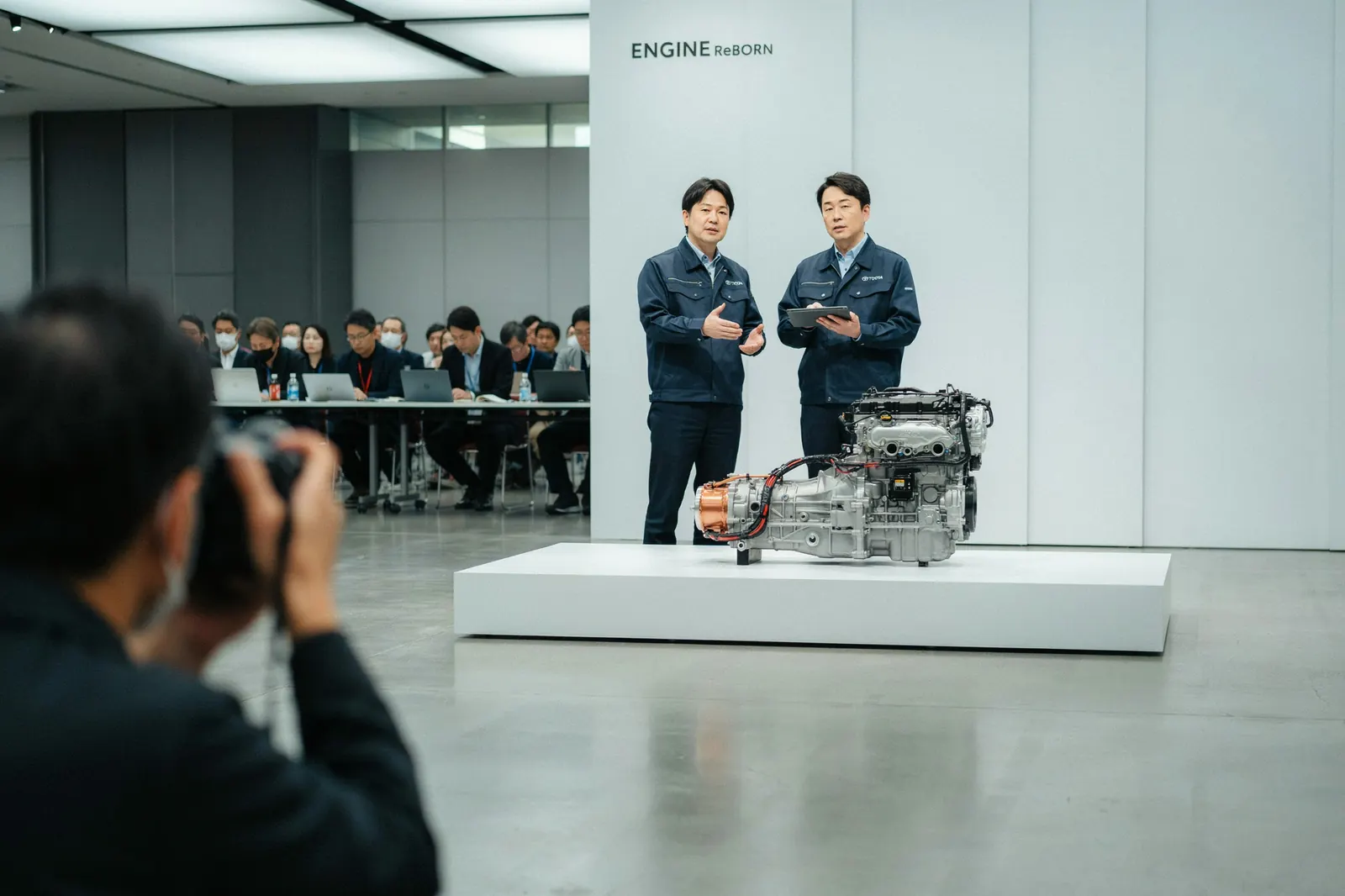
The buzz around a supposed “end of electric cars” thanks to a revolutionary Toyota engine regularly circulates on social networks and via YouTube videos with catchy titles. These pieces of content often mention Toyota, Lexus, other manufacturers such as BMW or Ford, suppliers and auto media, suggesting that a unique innovation radically changes the game and renders electric vehicles obsolete.
Verifiable origin of the subject
The core of the information goes back to the Multi-Pathway Workshop of May 28, 2024, organized jointly by Toyota, Subaru and Mazda. At this official event, the three manufacturers announced the development of new combustion engines adapted to the era of electrification and the goal of carbon neutrality. Toyota presented its family named “ENGINE ReBORN”: inline four-cylinder units of 1.5 liters (naturally aspirated and turbo) and 2.0 liters turbo. These engines are more compact (volume and height reductions on the order of 10 to 20% depending on the versions), designed to integrate optimally with electric motors and batteries in hybrid systems, and compatible with carbon-neutral fuels (e-fuels, biofuels, liquid hydrogen). The stated objective is to improve efficiency, enable more aerodynamic vehicle designs (lower hood) and meet future emissions standards while maintaining performance. Updates and technical details followed in 2025, notably at the Japan Mobility Show, with applications expected from late 2026 in hybrid, PHEV and sports models (including the G20E turbo aiming for around 400 hp for GR models).
Established facts
Toyota makes no secret of its preference for a multi-pathway approach: hybrids, plug-in hybrids, battery electric vehicles (BEVs), hydrogen fuel cells (FCEVs) and hydrogen combustion. The manufacturer continues to invest in and launch BEVs. Recent examples include evolutions of the bZ4X (new more efficient eAxle with silicon carbide semiconductors, improved ranges of up to about 570 km WLTP depending on versions, increased power outputs), the C-HR+, the Urban Cruiser, Touring/Woodland versions, and even an exclusively electric Highlander in some markets. Fully electric performance concepts and research on solid-state batteries continue. The new combustion engines do not replace electric power: they complement it, particularly for markets or uses where charging infrastructure or needs (towing, long distances) make hybrids more relevant. Toyota executives, including CTO Hiroki Nakajima and president Koji Sato, have insisted on optimizing the integration of combustion engine + electric power and on decarbonization via CN fuels, not on abandoning BEVs.
What is false, exaggerated or uncertain
The claim of an “end of electric cars” is a sensationalist exaggeration without foundation. No official statement from Toyota announces the disappearance of BEVs or a single engine that would render them useless. Viral headlines often recycle the 2024 announcement (or later updates) by distorting it, sometimes mixing in hydrogen combustion (GR Corolla H2 racing programs) or older rumors. On X and elsewhere, older posts already referred to a “hydrogen engine that destroys electric,” a classic of disinformation. There is no magical “ultimate engine” capable on its own of changing the global landscape. The advances are real in compactness, efficiency and versatility of combustion engines for hybrids, but they form part of a diversification, not an abandonment. Occasional brakes on certain next-gen BEV projects (such as a Lexus model) have been reported due to market demand, but Toyota is otherwise expanding its electric range and maintaining R&D.
Contradictions and blind spots
Toyota has been criticized for its slower pace on fully electric vehicles compared with some Chinese or European competitors, while being a leader in hybrids. The manufacturer acknowledges that electric has a role, but argues for solutions adapted to the energy and customer realities of each region (power grids, infrastructure). The new engines do not eliminate local emissions if they burn fossil fuels; their carbon benefit depends on the massive adoption of CN fuels, which is still limited. BEVs are also progressing in efficiency (eAxle, batteries) and Toyota is actively marketing them. The blind spot of buzz videos is often the absence of multi-pathway context and silence on parallel electric launches.
Provisional conclusion
The available evidence shows a real and documented Toyota innovation on modernized combustion engines for hybridization and decarbonization, within a diversified strategy formalized since 2024 and still current. This in no way constitutes the end of electric cars, which the manufacturer continues to develop and market. The verdict of alarmist headlines amounts to sensationalism. The automotive energy transition remains multi-technological, with uncertainties over the pace of adoption depending on markets, public policies and progress in batteries and infrastructure. Primary sources (Toyota press releases) and credible specialized press reports confirm this nuance.

Profile
Georges Darmond
Journaliste politique mediasJe m'appelle Georges. Je suis née dans la région parisienne où j'exerce mon métier de journalisme depuis 1 an dans le domaine du de la politique, médias, social. Aujourd'hui, je m'intéresse tout particulièrement à aux promesses non tenues, aux fausses informations, aux affirmations douteuses qui influencent notre quotidien, nos espoirs et notre espérance dans le futur.
LinkedIn ↗